When middle school math teachers completed an online professional development program that uses artificial intelligence to improve their math knowledge and teaching skills, their students’ math performance improved.
My colleagues and I developed this online professional development program, which relies on a virtual facilitator that can – among other things – present problems to the teacher around teaching math and provide feedback on the teacher’s answers.
Our goal was to enhance teachers’ mastery of knowledge and skills required to teach math effectively. These include understanding why the mathematical rules and procedures taught in school work. The program also focuses on common struggles students have as they learn a particular math concept, and how to use instructional tools and strategies to help them overcome these struggles.
We then conducted an experiment in which 53 middle school math teachers were randomly assigned to either this AI-based professional development or no additional training. On average, teachers spent 11 hours to complete the program. We then gave 1,727 of their students a math test. While students of these two groups of teachers started off with no difference in their math performance, the students taught by teachers who completed the program increased their mathematics performance by 0.18 of a standard deviation more on average. This is a statistically significant gain that is equal to the average math performance difference between sixth and seventh graders in the study.
Our project was funded by the Institute of Education Sciences, the research arm of the U.S. Department of Education.
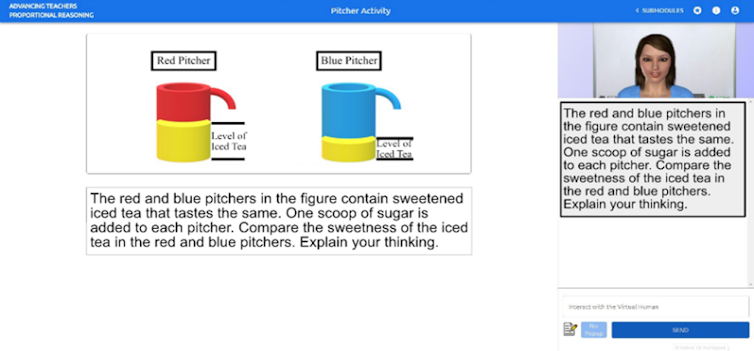
Sample activity from the program. University of Southern California, CC BY-NC-ND
Why it matters
This study demonstrates the potential for using AI technologies to create effective, widely accessible professional development for teachers. This is important because teachers often have limited access to high-quality professional development programs to improve their knowledge and teaching skills. Time conflicts or living in rural areas that are far from in-person professional development programs can prevent teachers from receiving the support they need.
Additionally, many existing in-person professional development programs for teachers have been shown to enhance participants’ teaching knowledge and practices but to have little impact on student achievement.
Effective professional development programs include opportunities for teachers to solve problems, analyze students’ work and observe teaching practices. Teachers also receive real-time support from the program facilitators. This is often a challenge for asynchronous online programs.
Our program addresses the limitations of asynchronous programs because the AI-supported virtual facilitator acts as a human instructor. It gives teachers authentic teaching activities to work on, asks questions to gauge their understanding and provides real-time feedback and guidance.
What’s next
Advancements in AI technologies will allow researchers to develop more interactive, personalized learning environments for teachers. For example, the language processing systems used in generative AI programs such as ChatGPT can improve the ability of these programs to analyze teachers’ responses more accurately and provide more personalized learning opportunities. Also, AI technologies can be used to develop new learning materials so that programs similar to ours can be developed faster.
More importantly, AI-based professional development programs can collect rich, real-time interaction data. Such data makes it possible to investigate how learning from professional development occurs and therefore how programs can be made more effective. Despite billions of dollars being spent each year on professional development for teachers, research suggests that how teachers learn through professional development is not yet well understood.