
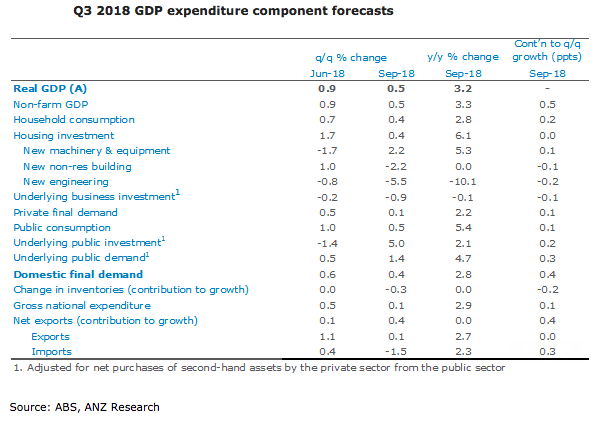
Australia’s gross domestic product (GDP) for the third quarter of this year is expected to have risen a relatively modest 0.5 percent q/q, following a gains of 1.1 percent and 0.9 percent in Q1 and Q2 respectively. This would see annual growth edge down to 3.2 percent.
At +0.5 percent q/q and +3.2 percent y/y, GDP growth looks to have been a little lower than the RBA expected. A step up to 0.9 percent q/q in Q4 would be required to achieve the 3-1/2 percent forecast for Dec 2018.
In tomorrow's report, the focus is likely once again to be on the household indicators - consumption and wages. Weak retail sales volumes (+0.2 percent) and car sales suggest a softer outcome for Q3 consumer spending.
Preliminary data from the business indicators report suggest that was likely to have been soft, with annual growth likely to have decelerated. The combination of weaker consumption and disappointing wages growth if confirmed in the GDP report would be a concern.
The RBA has so far been able to play down the implications of falling house prices, with the view that stronger growth in household income would provide enough support to consumer spending. But with house price weakness accelerating, wages slow to pick up and consumption softening, the outlook may not be so rosy.

