
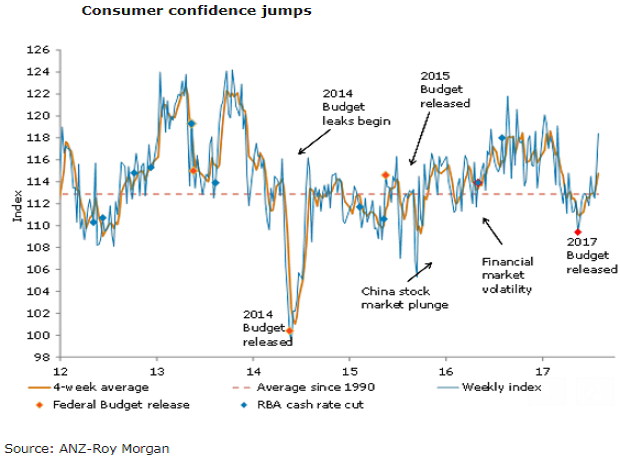
The ANZ-Roy Morgan Australian Consumer Confidence rose for the second straight week (up 2.9 percent) and now sits at its highest point since late February. Despite the jump in the headline index, the details were more mixed, with views towards economic conditions rising sharply but confidence in financial conditions easing a touch.
Households’ views on current and future financial conditions slipped 1.2 percent and 0.9 percent respectively. Both sub-indices remain above or close to their long term averages. Consumers’ views towards current economic conditions shot up 12.3 percent last week, bringing the sub-index to its highest point since September 2013. Views around future economic conditions also rose a solid 8.2 percent, following a 2.7 percent increase in the previous week.
The ‘time to buy a major household item’ rose 0.9 percent last week, following a 1.8 percent rise previously. This sub-index remains well above its long term average. Inflation expectations were unchanged at 4.3 percent on a four-week moving average basis, although the weekly value bounced to 4.4 percent.
"Going forward, it will be interesting to see if the upswing in confidence translates into higher spending. While the two are usually well correlated and recent retail sales data has been positive, we believe that sluggish wage growth, slower growth in house prices and the high level of household debt are likely to remain a drag," said David Plank, Head of Australian Economics, ANZ Research.
Meanwhile, FxWirePro launches Absolute Return Managed Program. For more details, visit http://www.fxwirepro.com/invest

