


 RBI Raises Repo Rate to 5.50% in Hawkish Shift on Inflation Risks
  Wall Street Falls as Oil Prices Rise and Tech Stocks Slide
  Asian Currencies Mixed as Yen Weakens, Dollar Holds Firm
  Gold Prices Hit One-Week High as Oil Falls, Fed Rate Outlook Weighed
  Gold Prices Rise as Dollar Weakens, Treasury Yields Fall
  Gold Prices Fall as Fed Signals Another Rate Hike


 Add as a preferred source on Google
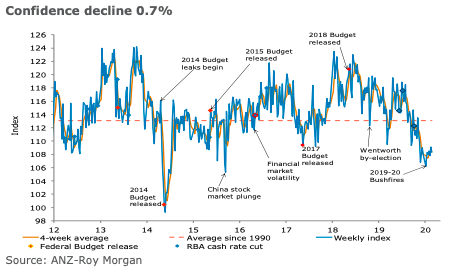
Australia’s ANZ-Roy Morgan consumer confidence declined 0.7 percent last week, driven lower by weakness in financial conditions.
‘Current finances’ fell 4 percent compared to the prior week, while ‘future finances’ declined 5.2 percent - its second straight weekly loss. In contrast to the weakness in financial conditions, confidence in economic conditions rose.
‘Current economic conditions’ gained 2.4 percent, building on the strong rise of 6.5 percent in the previous reading. ‘Future economic conditions’ rose 2.7 percent.
‘Time to buy a major household item’ gained 1.7 percent, after declining for two successive weeks. The four-week moving average for ‘inflation expectations’ was stable at 4 percent.
"A sharp rise in unemployment and underemployment may explain the fall in ANZ Roy-Morgan Australian Consumer Confidence index last week. Overall confidence is up from its recent low, though still well below average. The decline in confidence was due to weakness in the financial conditions subcomponent. It is possible that news about rising labour market has slack has people concerned about their personal finances. Sentiment toward ‘current finances’ is down 7.5% from its early January high, though still a touch above average. In contrast to the weakness in financial conditions, sentiment toward economic conditions was higher. It is still well below that on financial conditions, however, though the gap between the two has narrowed," said David Plank, ANZ’s Head of Australian Economics.







