


 US Treasury Yields Ease After Strong 10-Year Auction as Global Bonds Struggle
  Asian Stocks Mixed as OpenAI Revenue Concerns Hit Chipmakers
  Gold Prices Fall as Fed Signals Another Rate Hike
  Asian Currencies Mixed as Yen Weakens, Dollar Holds Firm
  Oil Prices Trim Gains After Trump Rules Out Iran Strikes Before Midterms
  European Stocks Fall as Oil Rises Ahead of Fed Minutes
  Bangladesh GDP Growth Accelerates to 4.6% on Industrial Rebound
  US Dollar Hits 18-Month High as Fed Signals More Rate Hikes
  Oil Prices Rise as Gulf Hurricane and Middle East Supply Risks Mount
  FxWirePro: Daily Commodity Tracker - 21st March, 2022
  Wall Street Falls as Fed Minutes Signal Another Rate Hike


 Add as a preferred source on Google
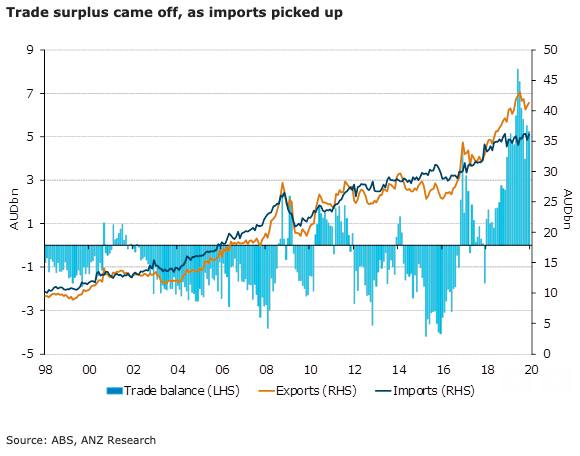
Australia’s trade surplus fell slightly to AUD5.2 billion in December, below market expectations. The decline was driven by a larger rise in imports compared to exports. Imports rose 2.4 percent m/m, while exports were up 1.4 percent m/m.
Stronger resource exports were the primary drivers of the pick-up in exports, while service exports fell. Imports were up across the board, with sharp rises in capital and consumption goods imports.
Total resource exports rose 2.9 percent m/m in December and are now 12.1 percent higher than a year ago. The increase largely reflects higher iron ore exports, which rose 3.3 percent m/m, as well as LNG, up 2.6 percent m/m.
Non-monetary gold continued its recent volatility rising 14 percent m/m after declining 6 percent in the previous month. The RBA’s commodity price index was down 1.1 percent in December, which suggests that the rise in resource exports was likely due to a rise in volume.
Manufacturing exports continued to decline, by 3.3 percent m/m. Service exports had the first material decline in some time, falling 1.1 percent m/m.
Capital goods were up 6 percent m/m, leading the increase in imports. A large part of this was due to increased transport equipment imports, which rose 23 percent m/m. Consumption goods had a strong month, largely reversing the decline from November. Fuel imports, for example, were up 4.7 percent m/m.
"Given the preliminary December quarter trade balance, net exports are unlikely to contribute much to GDP growth," ANZ Research commented in its latest report.







