
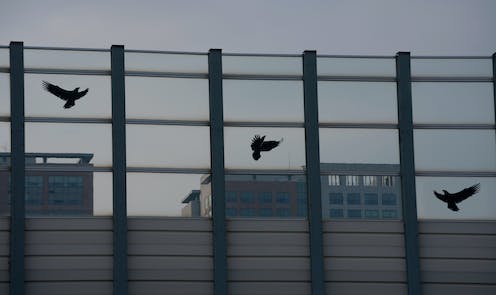
At least 1,000 birds were killed in one day in early October, when they collided with a single Chicago building, McCormick Place – the largest convention centre in North America. A paradigm of architectural modernism, McCormick Place was built in stages from 1960 to 2017, and is a steel, concrete and glass behemoth.
Although not particularly tall by contemporary standards, the building’s almost unbroken glass facade presents a problem for birds, most notably at night when the brilliantly lit interiors cause them to become confused. The thousand killed that day were a small proportion of the millions of migratory birds that were moving southwards across the continent to their wintering grounds – a journey undertaken twice yearly by these animals.
What makes this mass bird death unusual isn’t the number of animals that died (the American Bird Conservancy estimates that up to a billion birds suffer the same fate every year), but that it garnered so much public attention. This was thanks to the Chicago Bird Collision Monitors, a volunteer group that has recorded bird strikes in the city since 2003. According to their records, this was the largest number of dead birds recorded in the grounds of one building over a single day.
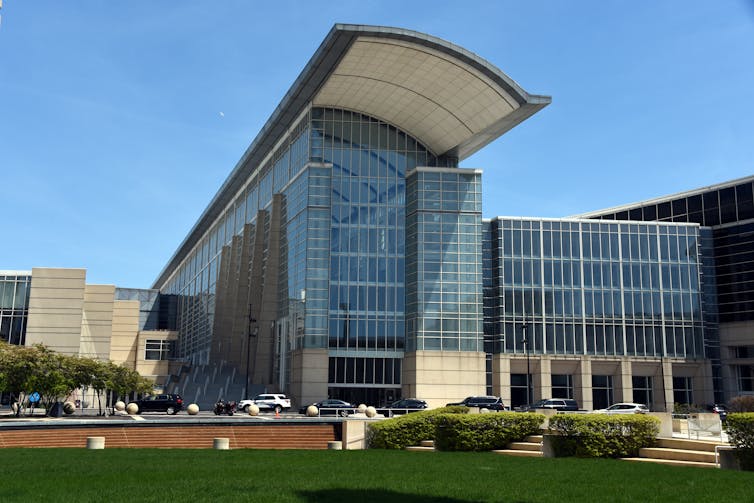
The sheer glass walls of McCormick Place can be difficult for birds to avoid. ChicagoPhotographer/Shutterstock
One way to prevent bird strikes is to pay more attention to the design of glass buildings in cities. Chicago set an example for this in 2009, when US architect Jeanne Gang’s Aqua Tower was completed. Its wave-like facade and fritted glass were in part designed to stop birds flying into the building’s windows. Fritted glass is printed with ink and contains ultra-small particles of ground-up glass, giving it a frosted or otherwise slightly opaque appearance.
This was just one aspect of Gang’s effort to “naturalise” the skyscraper – buildings that are typically composed of straight lines on account of their steel or concrete frames. As the Catalan architect Antoni Gaudí once quipped: “There are no straight lines or sharp corners in nature.”
Bird-safe glass
The Aqua Tower has curved balconies to soften the hard edges of what is an otherwise conventional skyscraper. The wave-like rippling effect also serves to minimise wind shear and create shade. In tandem with the fritted glass, the reflective qualities and hard edges of the glass are dampened, helping to prevent confusion, particularly at night.
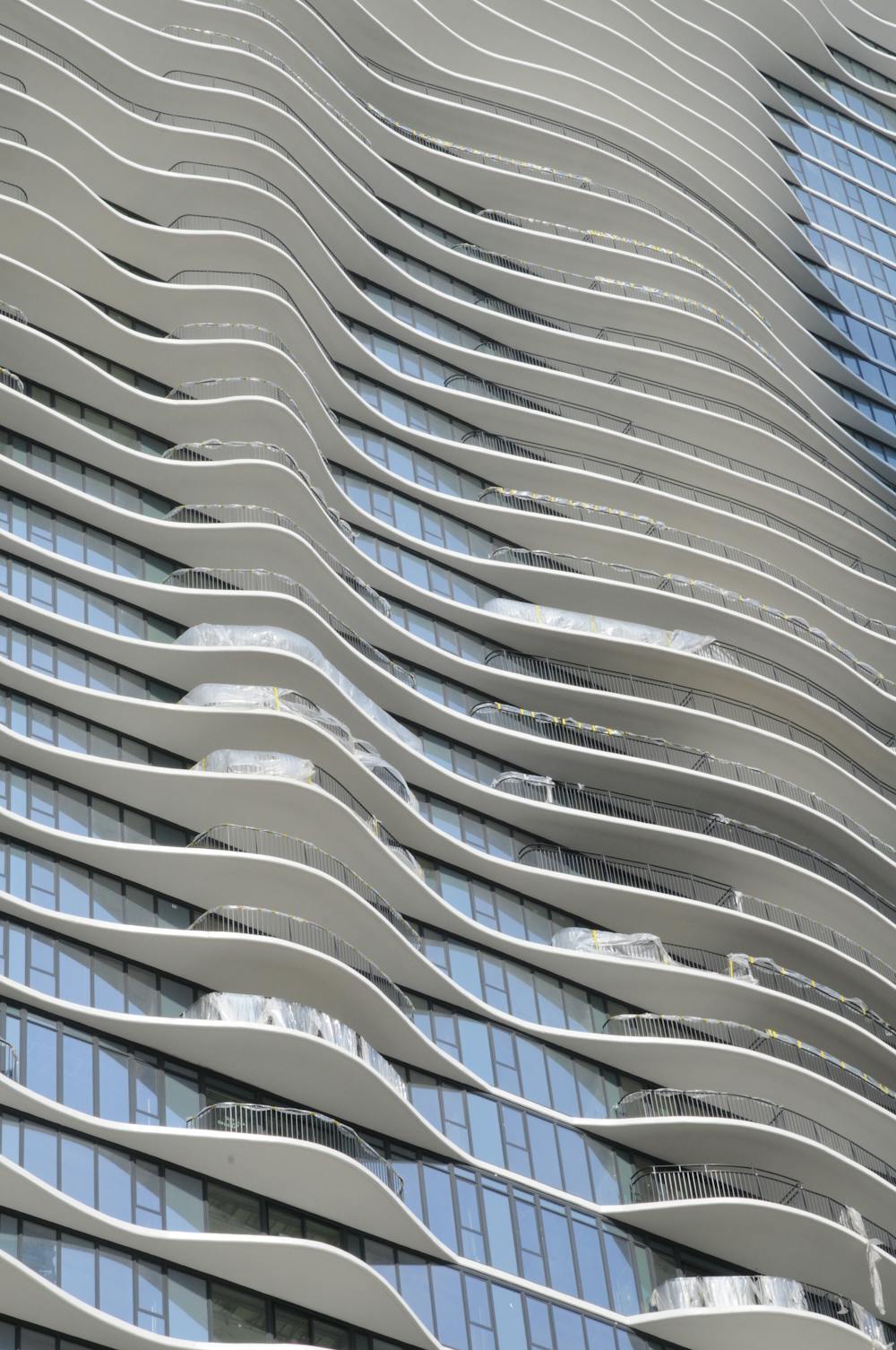
The Aqua Tower was the tallest woman-designed building in the world at the time of its completion. Paperclips0701
The tower demonstrates how architectural features usually chosen to enhance human lives can also benefit other organisms. This challenge was taken up by Buffalo-based architect Joyce Hwang in her project No Crash Zone from 2015. Hwang temporarily applied patterns to the windows of the Sullivan Center in Chicago, ostensibly to deter birds from flying into the glass, but also to add aesthetic interest to the material itself.
Hwang has argued that architects can still use glass in buildings – but with a little imagination, they can incorporate graphic ornamentation that will please us as well as other creatures (or maybe just not distract them).
More easily applied design solutions include bird-friendly film: a laminate of dots applied to glass to help birds see windows as objects rather than transparent, which minimises the risk of collision. This feature has been adopted by Columbia University in New York and several other buildings in the city, including a hotel, cemetery, mail facility and ferry terminal.
Lights out
The way humans make use of artificial light, it seems, is the more intractable problem when it comes to caring for birds.
In 2019, it was discovered that the annual Tribute in Light installation, held in New York City every year to mark the anniversary of the 9/11 attacks, caused migratory birds to become disorientated and exhausted. The birds are drawn to the four-mile high beams of light, veering off their migratory routes and becoming trapped by the spectacle.
In 2020, the decision was made to periodically switch off the lights and then restart them so that, even if the birds become disorientated, they can recover and continue on their way.
A 2021 study carried out in Chicago demonstrated the wider application of this principle: by shutting off half the lights in larger buildings at night, bird collisions can be reduced by anything from six- to 11-fold. At the time of writing, a change in the law is being debated in New York to prohibit nighttime illumination of unoccupied buildings. Many courtrooms, libraries and public schools in the city already turn off their lights during the bird migration season.
Whether these changes can spur a wider transformation of attitudes towards artificial light in cities is uncertain. After all, nighttime illumination is bound up with the 24/7 culture of cities, which has seen the natural cycles of light and dark long since banished. Today, the illuminated city only goes dark in extreme circumstances, like the widespread power failures across New York City that followed Hurricane Sandy in October 2012.
Yet people could choose other ways to use less artificial light. Darkness is a vital part of nature. It is the means by which animals, and plants, rest and take cover. For migratory birds, darkness is a safe place; it also allows them to perceive the world as they need to, with the light of the Moon and stars (and their sensitivity to the Earth’s magnetic field) guiding their long journeys.
Care for migratory birds could also yield a greater appreciation of dark skies. Making nighttime cities more bird-friendly might help human residents reconnect with the beauty and awe that these vistas inspire.


#/media/File:AquaTower2009_02_08_image2.jpg)