


 RBI Raises Repo Rate to 5.50% in Hawkish Shift on Inflation Risks
  Best Gold Stocks to Buy Now: AABB, GOLD, GDX
  Fed’s Logan Signals 50 Basis Points More in Rate Hikes
  BOJ Signals Faster Rate Hikes as Inflation Risks Grow
  ECB May Stop Rate Hikes After December, Capital Economics Says


 Add as a preferred source on Google
In the past few months, global economic uncertainty has put downward pressure on the price of Canada's resources, weighing on the nation's already beleaguered resource patch.
The price of WTI oil is $45/bbl (as this goes to print), roughly $15/bbl below the July MPR assumption. Thus, the Bank of Canada's (BoC) hopes for in-quarter growth of around 2.8% annualized in 2016 may be difficult to achieve, leaving a wide and persistent negative output gap.
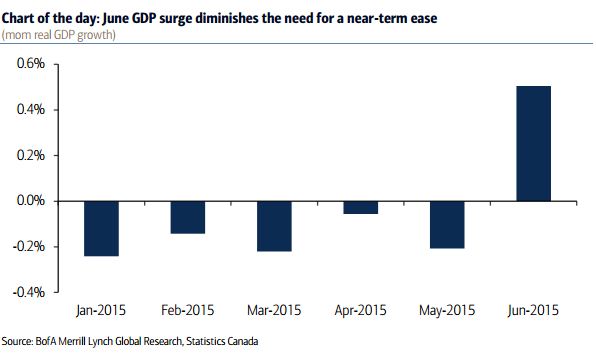
A few weeks ago, a September ease looked somewhat likely. However, oil prices have crept higher, and global headline growth risk has faded. Most importantly, recent news from Canadian economy has been encouraging, with GDP growth in Q2 of -0.5%, in line with the BoC's expectations. June GDP rose by a whopping 0.5% m/m, pointing to a solid end to a very weak first half of the year (Chart of the day). Thus, even, with underlying economic weakness likely on the horizon, there is little reason for the BoC to jump the gun and ease the overnight rate in September.
The BoC will likely nudge the overnight rate down in October if oil prices remain subdued and growth remains tepid, as further stimulus would be needed eliminate economic slack. Although the BoC will likely cite signs that growth is progressing in line with their expectations, global growth uncertainty and downward commodity price pressure should be cited as potential risks. As a mild offset, the CAD depreciation, which in part may have supported by a healthy increase in non-energy export volumes should be cited as a benefit. But the tone on these two offsetting forces should be neutral as it's still too early to tell the ultimate fallout.







