


 Kalshi Withdraws PEPE Perpetual Futures Filing
  RBA Says ASX Still Falls Short on Governance and Risk Controls
  Bitcoin Outflows From Binance Hit Three-Year High as Whales Accumulate
  Yen in Focus as BOJ, Fed Rate Hikes Reshape Currency Markets
  Fed Unveils Stablecoin Rules Under GENIUS Act
  Solana User Growth Jumps 33%, Outpacing Ethereum and Chainlink
  Sector Spotlight: Data Availability and Storage Lead 24-Hour Market Gains
  JPMorgan CEO Jamie Dimon Warns Mythos AI Raises Cyber Risk Tenfold
  RBI Rate Hike Bets Surge as Inflation Rises
  Iran Tanker Attacks Surge as Hormuz Oil Flows Near Prewar Levels
  Indian Stocks Fall as RBI Hikes Rates to 5.50%
  Fed’s Hammack Says More Data Needed Before Next Rate Move
  Deere, CNH and AGCO Stocks Fall as FTC Launches Farm Equipment Probe


 Add as a preferred source on Google
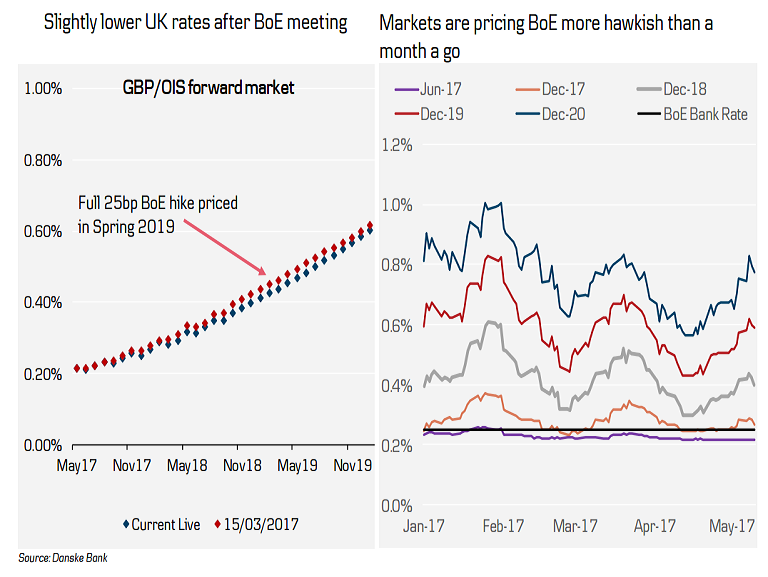
The Bank of England's (BoE) Monetary Policy Committee (MPC) on Thursday voted by a majority of 7-1 votes to leave the bank rate unchanged at 0.25 percent as widely expected by the markets. The central bank also maintained the asset purchase programme at £435bn. Kristin Forbes was again the only member to vote for a hike. The MPC left open the door to further easing if things turn out weaker than anticipated. MPC stated that ‘policy can respond in either direction to changes to the economic outlook as they unfold.'
The BoE has lowered its CPI inflation projections and expects GDP growth of around 1.75 percent in coming years. The projection for the unemployment rate has been lowered as the projection for GDP growth has been lifted. The central bank said that ‘the projected overshoot entirely reflects’ the GBP depreciation and that ‘although domestically generated inflation had been rising, it was currently below the level broadly consistent with the inflation target’. Hence, only a higher domestically generated inflation could act as a trigger for a more hawkish BoE.
The policy statement released thereafter supported the view that, on the assumption of a “smooth” transition to Brexit, monetary policy will likely tighten by a somewhat greater extent than the market is currently pricing-in. The BoE's central projection assumes that, over the near term, the ongoing slowdown in consumer spending will be largely balanced by rising investment and stronger net exports. It also assumes that wage growth will pick up steadily to 3¾ percent Y/Y in 2019.
However, in spite of the modestly hawkish bias of the BoE statement, Pound hits one-week low. GBP came under pressure across the board as market were expecting at least two dissenting votes in favor of higher interest rates on the back of increased inflation pressures triggered by GBP’s post-Brexit depreciation, but Kristin Forbes was again the sole dissenter.
"Given our expectation that GDP and wage growth will be weaker than the BoE expects, and the profound risks relating to the UK’s future relationship with the EU, we continue to forecast that Bank Rate will be left unchanged over the remainder of 2017 and throughout 2018. The direction of policy thereafter will be determined by the outcome of the Brexit negotiations," said Chris Scicluna at Daiwa Capital Markets in a report.
Pound was extending weakness on Friday. GBP/USD was down 0.29 percent at 1.2850, while EUR/GBP was up 0.43 percent at 0.8462 at around 1130 GMT. At the same time FxWirePro's Hourly GBP Spot Index was at -74.6266 (Slightly bearish). For more details on FxWirePro's Currency Strength Index, visit http://www.fxwirepro.com/currencyindex.







