


 US Dollar Hits 18-Month High as Fed Signals More Rate Hikes
  Wall Street Falls as Fed Minutes Signal Another Rate Hike
  Cardano Price Eyes $0.30 as ADA Whale Activity Surges
  Fed’s Williams Signals One More Rate Hike Before Year-End
  Trump Demands Powell Resign Over Fed Renovation Cost Overruns
  Fed Unveils Stablecoin Rules Under GENIUS Act
  RBA Hikes Interest Rate to 4.60% as Inflation Risks Rise
  Kazakhstan and Tether Explore Tenge Stablecoin and RWA Tokenization
  ECB May Stop Rate Hikes After December, Capital Economics Says
  Bangladesh GDP Growth Accelerates to 4.6% on Industrial Rebound
  Jay Clayton Named Trump’s AI Czar as XRP Past Resurfaces
  Deere, CNH and AGCO Stocks Fall as FTC Launches Farm Equipment Probe
  Oil Prices Rise as Hormuz Risks Offset IEA Stock Release
  Crypto Market Selloff Wipes Out $100B as Bitcoin Falls Below $83K


 Add as a preferred source on Google
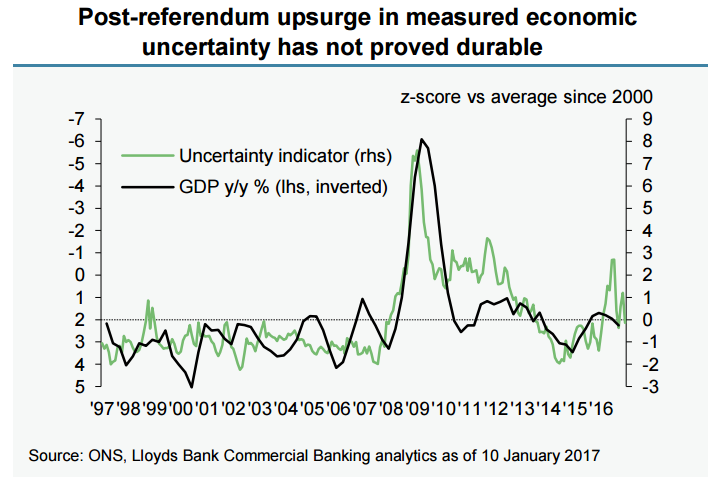
Incoming economic data in UK do not support the view of an uncertainty driven slowdown in the aftermath of the EU referendum. UK economy expanded at 0.6 percent q/q in Q3 2016, the first full post-referendum quarter. The economy’s dominant services sector saw a brisk 1.0 percent q/q growth in Q3.
Composite PMI in December spanning across the manufacturing, construction and services sectors stood at its strongest since July 2015. Survey data for Q4 have also been solid and analysts expect overall GDP growth in Q4 could post a 0.5 percent q/q rise. Together with the recent history of GDP data, that would leave growth in the six months since the referendum, in fact, quicker than in the first half of 2016. And the apparent resilience towards the end of 2016 suggests that some of this momentum is likely to carry over into H1 2017.
Inflation in the UK is likely to rise through 2 percent target by spring 2017 as currency weakness drives import price rises. The coming few months are likely to see a sharp rise in the headline inflation rate on the back of significant impact from energy price base effects and as the exchange rate pass-through becomes dominant.
"We expect CPI inflation to tick up further to 1.3% by December and burst through the 2% target by spring 2017. Easing underlying cost pressures from the second half of 2017 should provide some offset as growth in the economy slows modestly and reduced labour market tightness limits inflation’s overshoot relative to target." said Lloyds bank in a report.
As exit negotiations with the European Union begin, how measures of uncertainty evolve over the coming months and how strong the mapping proves with official activity data are among the key questions for the near-term outlook. The deceleration of economic activity over the course of 2017 and 2018 is likely to principally result from the weakness of sterling.
UK Monetary Policy Committee (MPC) is likely to look through inflation rise, but could react if activity slowdown proves more modest than expected. "Our base scenario sees Bank Rate on hold for the foreseeable future, but with a skew towards tighter policy," adds Lloyd's Bank in a report.
GBP/USD tests 1.21, weakest since Oct 7 'flash crash'. Cable continued slump as Hard-Brexit concerns continued to weigh on the investors’ sentiment. EUR/GBP spiked beyond 0.8750 to hit fresh multi-week highs at 0.8763.
FxWirePro Currency Strength Index showed Hourly GBP Spot Index at -91.9716 (Highly Bearish) at 1130 GMT. For more details on FxWirePro's Currency Strength Index, visit http://www.fxwirepro.com/currencyindex.







