
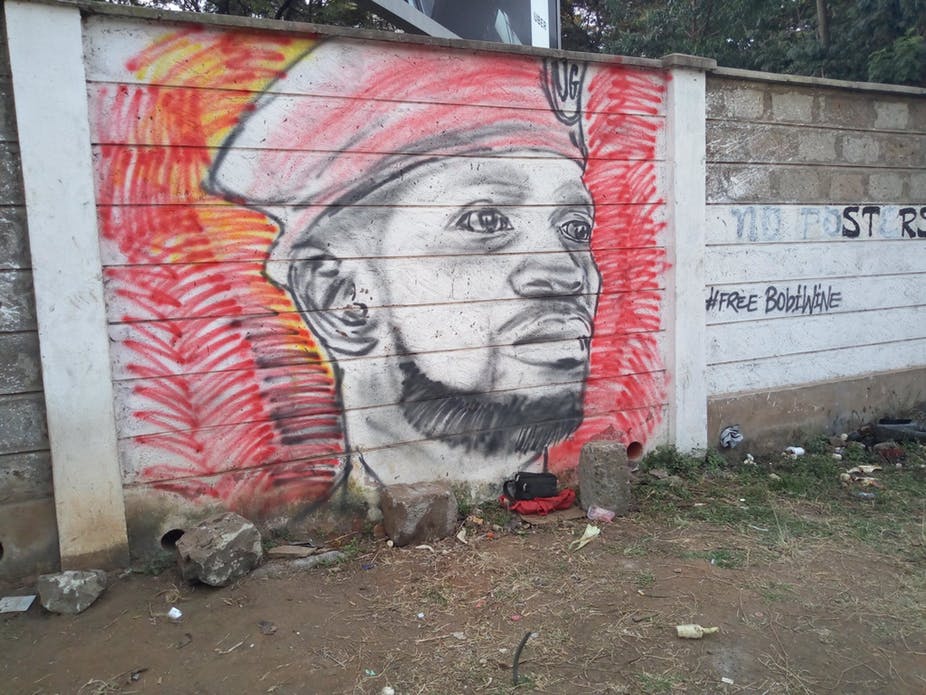
Robert Kyagulanyi Ssentamu, also known as Bobi Wine, is a Ugandan politician whose arrest and incarceration has sparked widespread protests in Uganda and elsewhere in the East African region. A great deal of this can be attributed to social media, which quickly spread his story. The Conversation Africa spoke to Philip Ephraim about social media, and the impact it can have on politics.
How has social media been used in the Bobi Wine saga?
From what I’ve seen, most major social media tools —-Twitter, Facebook, YouTube and Instagram —- have all been used. In my opinion, Twitter has been the most prominent of these platforms. The video of Bobi Wine’s arrest and the hashtag #freebobiwine first appeared on Twitter on the morning following his arrest and soon began to trend. It has since gone viral across various social media and mainstream platforms.
Over ten days, 60 twitter accounts have so far either been created or renamed to promote the hashtag with over 100,000 tweets. And I’ve seen four accounts created on Facebook.
In this way, social media is being used as an advocacy tool to challenge Ugandan President Yoweri Museveni —- who has been in power for over 30 years —- and his regime’s oppressive tactics.
What has the impact of this online activity been?
Unlike traditional media, social media has the unique capacity to make messages go viral. It can reach audiences worldwide within minutes through content sharing.
Social media has played a central role in attracting attention to the plight of Bobi Wine across the world. It has kept the general public up to date on his court case, the arrest of his friends and coworkers and on his physical health.
Personally, I became aware of this situation through a Kenyan YouTube channel which announced the incident and sought to drum up support for Bobi Wine. This prompted me to look further into what was happening to him.
The activity on social media has been translated into actual, physical action. Concerts and rallies calling for his release have been held in South Africa and neighbouring countries such as Kenya.
And the message has spread beyond Africa’s borders, which is probably at least partly because of social media’s enormous reach. There have even been protests in London calling for his release. International artists like Chris Martin from Coldplay and Damon Albarn from Blur are among those who’ve come out in support of Bobi Wine.
What has the Ugandan government’s reaction been?
Uganda’s government has a turbulent relationship with social media, which it’s trying to control – but can’t. Earlier this year a social media tax was introduced which means that Ugandans pay USD$0.05 a day to use popular platforms like Twitter or WhatsApp.
So, it’s no surprise that the government’s reaction has been defensive. It has tried to justify its actions, accusing Bobi Wine of leading a group of protesters to attack the president and his military and police convoy with stones and illegal firearms with a view to politically destabilise Uganda. In this way the government has framed itself as engaging in self defence against violent protesters.
It has also tried to discredit the information being shared online. President Museveni has dismissed information about Bobi Wine’s beating and injuries as “fake news”.
And recent media reports have tried to reinforce a positive, magnanimous image of the Ugandan government, for instance saying it will allow Bobi Wine to be flown abroad for medical treatment.
*What concerns are there when social media is used to address politics? *
A central issue is the lack of gatekeeping. Anyone can produce and share sensational content on social media. In this way the porous nature of social media fuels the spread of disinformation and misinformation and the notorious “fake news”. This means not all content will be, or should be trusted. This could hurt a cause.
For instance, there’s already information emerging that suggests Boni Wine’s condition might not have been as critical as was portrayed in some messages that circulated on social media. Other reports declared that Bobi Wine had been shot dead with his driver; some claimed he’d been beaten to a pulp and was blind and completely paralysed. However, evidence has emerged that he was able to receive visits from family and close friends including his wife and even wrote letters while in detention.
The Ugandan government has already accused the media and the opposition of spreading fake news to fuel anarchy and chaos.
Do you think social media can play a role in protecting democracy?
Indeed, social media functions are a powerful tool in promoting democracy through:
-
Creating public awareness about politics and politicians;
-
Promoting political education through educating the public on voting and elections;
-
Serving as platforms for political campaign for both government and the opposition; and
-
Providing platforms for dissent in controlled societies.


