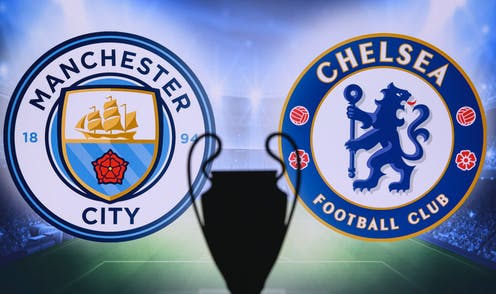
On the night of the 2021 UEFA Champions League Final, Chelsea and Manchester City will battle it out for European glory. Only one of the two English teams will walk away with the trophy – but despite the rivalry on the field, both sides have plenty in common off the pitch.
They were, for instance, part of a doomed attempt to usurp the very tournament they are trying to win, with the establishment of a European Super League. That plan, involving 12 of the biggest clubs in the world, collapsed in the face of unfiltered outrage from fans, pundits and politicians – and crucially, a change of heart at Chelsea and Manchester City.
The Super League house of cards seems to have truly started falling when Chelsea announced its intention to withdraw from the competition. Their move was followed a few hours later by a similar statement from City.
There have been reports that Chelsea’s U-turn was prompted by a telephone call from Russian president Vladimir Putin to his compatriot Roman Abramovich, the billionaire who owns the London club. Some media outlets have even suggested that Putin declared a super league would be “against the spirit of the fatherland”.
But however those decisions came to be made, the reality of the geopolitical and economic basis of European football is clear. And this is where the Champions League action becomes particularly interesting, especially in its associations with oil and gas.
Russia’s Gazprom – a corporation with origins as a state energy producer dating back to the old Soviet Union – has been a major sponsor of the competition since 2012, and has just announced a big new deal with UEFA.
Gazprom was privatised during the early 1990s reform period in Russia, but Putin’s ascent subsequently led to a majority of the company’s shares being taken back into state ownership. Gazprom later acquired a rival energy company, the oil firm Sibneft, owned at the time by Abramovich.
Gazprom, which is based in Putin’s home town of St Petersburg, also owns the local club, Zenit Saint Petersburg. The former president of Zenit is Alexander Dyukov, a man who is also president of the Russian Football Union. In addition, Dyukov is chief executive of Gazprom and, in the middle of the Super League debacle, he was elected to the executive committee of UEFA.
If Putin really did call Abramovich about the Super League, it could be seen as yet another episode in Russia’s engagement with football as a geopolitical and diplomatic tool.
For many years, some observers have wondered why an organisation that sells gas to governments sits alongside the likes of McDonald’s and Coca Cola as a Champions League sponsor. But the answer to this can be found in the way that Gazprom enables Russia to project soft power and build legitimacy through its associations with the world’s favourite game.
During his time as US president, Donald Trump was bullish towards Russian energy suppliers, and even imposed sanctions upon Gazprom. Trump claimed that Europe’s growing dependency on Russian energy supplies, especially in Germany (where Gazprom sponsors FC Schalke 04), constitutes a strategic threat to the continent’s security. The Joe Biden administration holds similar concerns.
But perhaps being a sponsor of the tournament and having a strong relationship with both UEFA and Chelsea isn’t enough. For Gazprom also continues to strengthen its relations with Abu Dhabi, the small Gulf state which, via a member of its royal family, owns a majority stake in Manchester City.
Gas goals
Like Russia, Abu Dhabi owns some of the world’s largest carbon fuel reserves. In this sense, the Champions League final will therefore be a game powered by gas and oil.
Over the last decade, relations between Russia and Abu Dhabi have strengthened, leading to a series of strategic agreements, the most significant of which was signed in 2018. Described as a watershed in bilateral relations, it covered all manner of issues in investment, trade, culture, space, tourism and security.
One outcome of this was the acquisition by Abu Dhabi’s state-owned Mubadala Investment Company of a $US271 million (£191 million), 44% stake in one of Gazprom’s subsidiaries. In 2019, the Abu Dhabi National Oil Company then signed a strategic framework agreement with Gazprom to explore for and extract new oil reserves.
This led to a 2020 announcement that Gazprom and Mubadala will engage in technological cooperation in Siberia, where coincidentally Abramovich began building his gas powered fortune.
Come match day, most fans of City and Chelsea will not be overly concerned by the origins of the cash that has fuelled their clubs’ success. And with talk of a super league fading and many football fans hailing its defeat, some will see the Champions League Final as a victory parade for normality.
But this would be naive and misguided. For football has not merely been commercialised and industrialised over the last 30 years. It has also become intensely geopolitical, and sits at the heart of a complex global network of interests and investments. Indeed, for some powerful players, the sport has become a tactically astute means to extremely lucrative other ends – as epitomised by this year’s Champions League final.