
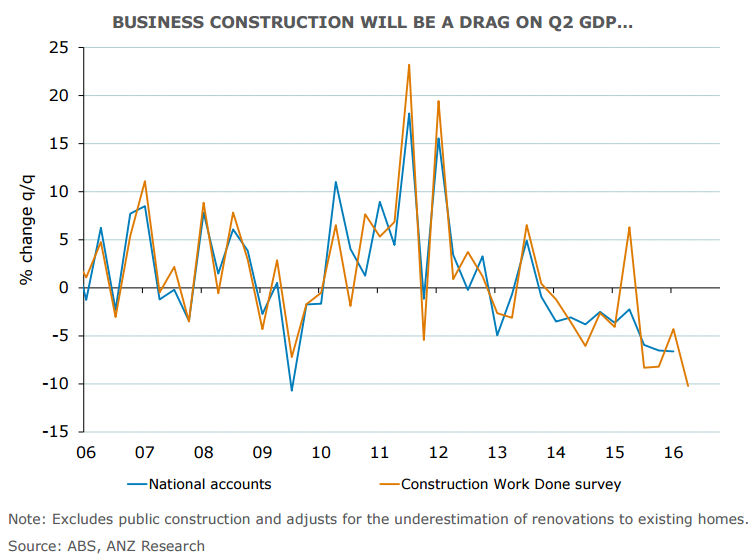
Australia's total construction work done fell sharply in Q2. Data released by the Australian Bureau of Statistics on Wednesday showed that the total value of construction work completed in Australia fell 3.7 percent in the second quarter from the first quarter to A$47.42 billion. It was the largest q/q fall since Q3 2015, and was 11 perent lower than a year ago.
Steep fall in mining-related engineering construction likely drove the fall in total construction. Private engineering construction fell by 14 percent in Q2, which was the largest fall since the early 1980s recession. Australia's economy is experiencing the maximum drag from the unwinding of the record boom in resource-sector investment.
Residential investment posted another solid gain, but the weakness in engineering likely offset the gains. Residential construction rose solidly in Q2, while non-residential building remained little changed. Home building was up a healthy 9.7 percent at A$17 billion during the quarter, benefiting from historically low mortgage rates and brisk population growth.
Government investment is finally witnessing the long-awaited recovery as spending on public works expanded at a double-digit pace in Q2 to hit the highest in more than two years. Total public construction rose by 5 percent in Q2 with growth broad-based. Public housing, non-residential, and engineering construction all posted solid increases. However, it is to be noted that public construction data do not feed into GDP.
The Reserve bank of Australia cut its benchmark interest rates in May and August taking them to an all-time low of 1.5 percent. The climb in residential construction will reassure the central bank that monetary stimulus is working. Strong demand from housing activity has helped to ensure a smooth and broadly steady transition from unwinding of the record boom in resource-sector investment.
"Falling construction work would probably lop 0.5 percent off second quarter GDP, having already subtracted 0.1 percent from the first quarter," notes ANZ economist Daniel Gradwell in a report.
AUD/USD was trading 0.09 percent higher on the day at around 0.7620 at 10:30 GMT. Upside in the pair remains capped by 20-day MA at 0.7630. Major trendline support is seen at 0.7545. Near-term trend is higher, weakness only below 0.7545.


