“Dante was the founder of right-wing thinking in our country”. So proclaimed Italy’s culture minister, Gennaro Sangiuliano, at an electoral meeting of the prime minister Giorgia Meloni’s party, Fratelli d’Italia, in January.
He went on to say that “Dante’s vision of mankind and relationships, as well as his political construction, are deeply right-wing”.
The statement caused uproar in Italy. Among left-wing politicians and literary critics, the collective mood feels ready to shout, with one voice: Giù le mani da Dante (hands off Dante).
The reality is there are many interpretations of Dante. Sangiuliano’s reading is not particularly sophisticated, but it requires attention because of his allusion to Dante as a totem of Italian nationalism.
‘The most Italian of all Italians’
Poet and philosopher Dante Alighieri (1265-1321) – whose work includes the Divine Comedy, one of the landmarks of western literature – is considered a source of national pride in Italy. As the celebrations for the seventh centenary of his death in 2021 demonstrated, Dante’s memory and Italian identity are deeply intertwined.
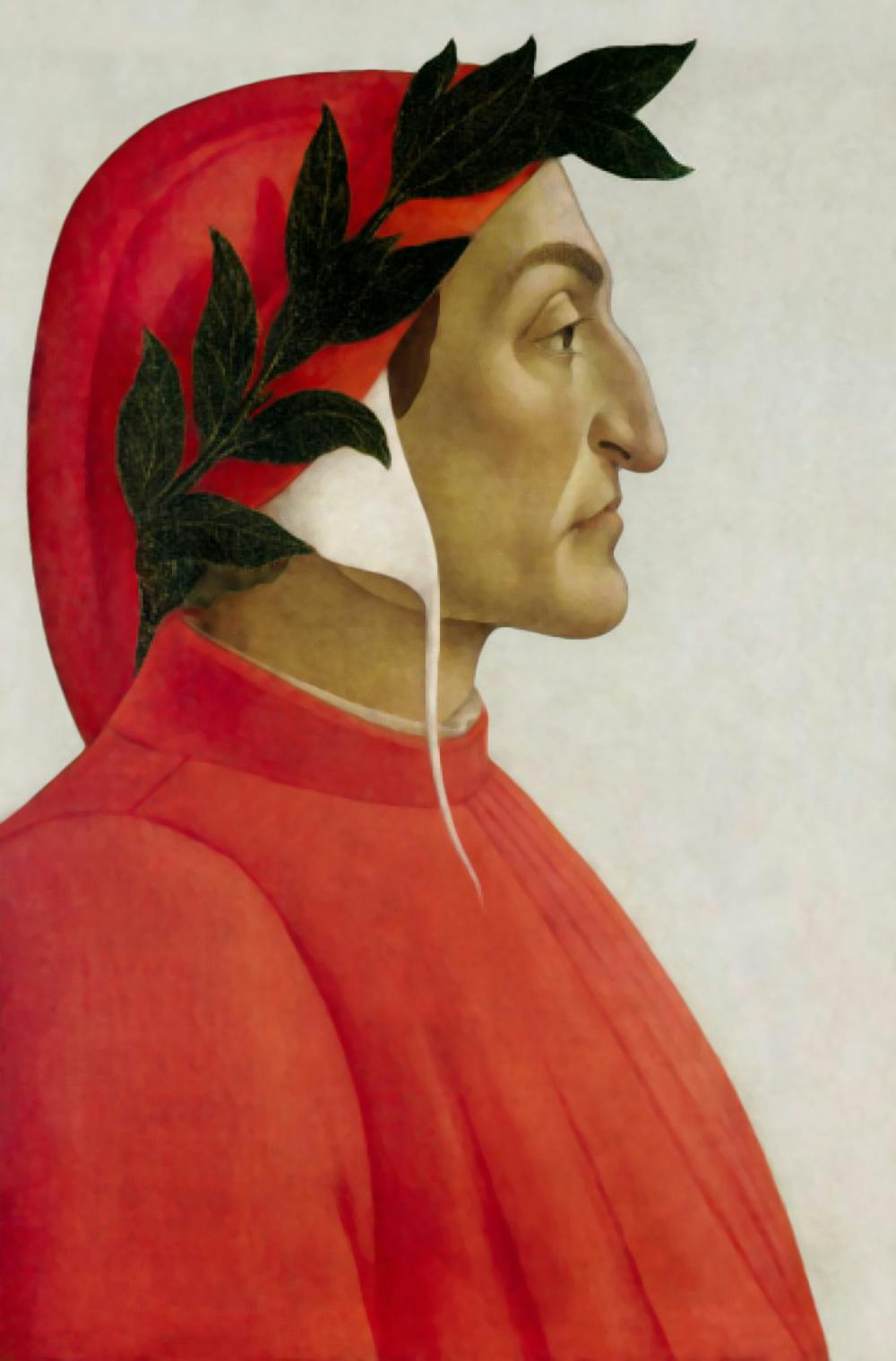
Posthumous portrait of Dante by Sandro Botticelli (1495).
The identification between Dante and Italy dates back to the process of unification of Italy (the Risorgimento). At that time, Dante was proclaimed padre della patria (father of the country) by many, including two of the most influential Italian intellectual leaders – writer Ugo Foscolo (1778-1827) and politician Giuseppe Mazzini (1805-1872).
The historian Cesare Balbo (1789-1853) called Dante “the most Italian of all Italians”. Philosopher Giovanni Gentile (1875-1944) who was later minister of education under Mussolini’s government and a member of the Italian Fascist Party, asserted that, “with Dante the idea of Italy began to take hold”.
In recent times, Dante has been equated with an abstract idea of Italy by left-wing politicians too, like former Minister of Culture Dario Franceschini, who in 2021 stated that “Dante is the very idea of Italy”. In the same year, President Sergio Mattarella argued that “Dante is actually the great prophet of Italy.”
The many appropriations of Dante
Appropriations of Dante are typical of many different cultural environments, but right-wing speakers tend to add a dash of nationalism in order to generate populist ideologies.
There have been – predictably – Catholic appropriations, with three official papal documents published on Dante: Benedetto XV’s encyclical In Praeclara Summorum (1921), Paul VI’s apostolic letter Altissimi Cantus (1965) and Francis I’s apostolic letter, Candor Lucis Aeternae (2021).
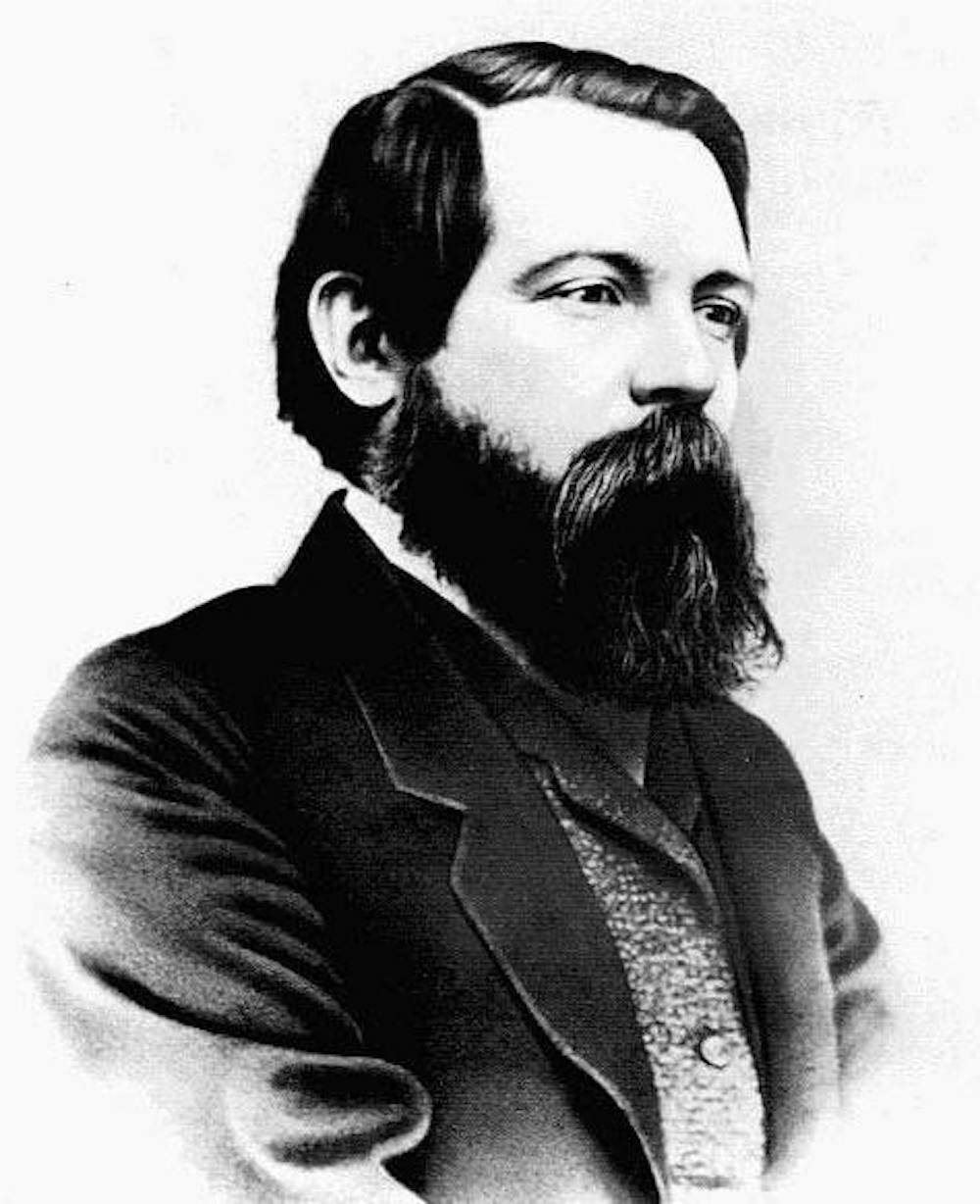
Friedrich Engels (pictured in 1868) dubbed Dante ‘both the last poet of the Middle Ages and the first poet of modern times’. George Lester
There have been Communist appropriations. In the preface to the Italian edition (1893) of Marx and Engels’s Manifesto of the Communist Party, Dante is defined as “both the last poet of the Middle Ages and the first poet of modern times”.
And there have also been fascist appropriations. During Mussolini’s regime (1922-1945), two books were published associating Dante and Mussolini: Dante Alighieri e Benito Mussolini (1927) by historian Domenico Venturini and Dante e Mussolini (1934) by critic Tommaso Vitti.
The fascist militant Pietro Jacopini, captain of the Royal Guardia di Finanza, in a 1928 essay dedicated to a political reading of canto six of Purgatorio, went to the extent of proclaiming that:
Dante is a forerunner of Fascism and, if he had lived today, he would certainly have honoured us with his company, holding his truncheon against all the socialists and communists.
The dangers of evoking Dante
Sangiuliano is free to take inspiration from whatever sources he wishes but as these antecedents demonstrate, his words lean dangerously towards fascist interpretations.
For many readers of Dante, there is in fact no connection between Dante and right-wing thinking.
If right-wing thinking implies individualism, Dante was communitarian (believing that we are moulded by our communities). If typical right-wing values are aggression, competition and authoritarianism, Dante’s message is fraternity, solidarity and free-will. If identity and nationalism mark right-wing policies, the Divine Comedy is all universalism, based as it is on a series of meetings that explore the variety of human nature.
As an expert in Dante’s writing, I would urge Sangiuliano to read and reread Dante. What we need to learn from him in our time of enduring conflicts and ideological divides is his curiosity about human nature, nurtured with intellectual challenges and moral questions, rather than making him fit within any political system.