


 BOJ Signals Faster Rate Hikes as Inflation Risks Grow
  RBA Says ASX Still Falls Short on Governance and Risk Controls
  ECB May Stop Rate Hikes After December, Capital Economics Says
  Best Gold Stocks to Buy Now: AABB, GOLD, GDX
  Fed Unveils Stablecoin Rules Under GENIUS Act
  RBI Raises Repo Rate to 5.50% in Hawkish Shift on Inflation Risks
  Yen in Focus as BOJ, Fed Rate Hikes Reshape Currency Markets
  Trump Demands Powell Resign Over Fed Renovation Cost Overruns


 Add as a preferred source on Google
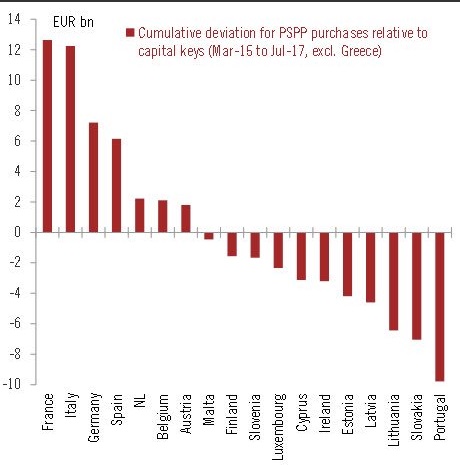
When the European Central Bank (ECB), the latecomer in the Quantitative Easing (QE) program announced its Public Sector Purchase Program (PSPP) in 2015, it was said that the program would follow the central bank’s capital key structure. The structure is based on individual countries or central bank’s contribution to European Central Bank’s (ECB) base capital. However, in reality, after years of PSPP, the deviation from key capital ratio is quite large and the gap is likely to grow if ECB continues further on its bond buying program.
According to data, while ECB bought more bonds than key capital for Italy, France, Germany, Spain, Netherlands, and Belgium, it has bought lesser amounts than the key capital for rest of the Eurozone. ECB didn’t buy any Greek bonds. The gap is highest for Franc and Italy with around €12 billion. And on the downside, the gap is largest for Portugal (approx. €10 billion).
The gap could continue for many economies and even expand if ECB continues to expand its balance sheet without changing the current rules. To give an example, as of now, ECB has bought €10 billion less of Portugal bonds than key capital ratio requires but the current bond purchase has already hit 30 percent issuer limit, whereas the rules bar ECB from buying more than 33 percent bonds for any issuer.







