


 Huawei, Qualcomm Sign Multi-Year AI and 5G Patent Deal
  Revolut Challenges Europe’s Banking Giants as Global Growth Accelerates
  NEAR Price Rally Cools as $4.60 Support Takes Focus
  Zcash NU7 Testnet Cuts Block Time to 25 Seconds
  Italgas to Buy 22.5% Stake in Portugal’s Floene for €120 Million
  OKXICE Files for 24/7 Tokenized US Stock Trading
  Nippon Paint Shares Rise on $1.35 Billion AkzoNobel Deal
  Airbus Spain Workers Approve Deal to End Months of Strikes
  Disney Plans TV Restructuring With Hundreds of Layoffs
  AAVE, PUMP, WLD and SKY Rally as Crypto Market Slips
  Volvo Cars Drops Full-Year Outlook as China, US Sales Weaken
  Kraken Parent Payward Adds 24/7 Settlement With Singapore Gulf Bank
  Bank of America Sees EUR/USD at 1.15 by Year-End
  Flydubai FZ1073 Co-Pilot Accused of Terror Attack
  Coinbase, Circle Stocks Slide as Bank Group Sues OCC Over Crypto Charters
  Revolut Challenges Banking Giants With Global Expansion
  Supreme Court Takes Up Exxon, Suncor Climate Case


 Add as a preferred source on Google


We are all familiar with the greenhouse gas emissions that come from burning fossil fuels in car engines, central heating systems and power stations. Little discussed is the climate footprint of producing oil and gas in the first place.
Extracting, refining and distributing oil and gas requires energy. Pumps, compressors, heaters and drilling units treat and move the fuels from many kilometres underground using electricity typically generated by gas turbines. Clearly, burning gas at offshore production sites will result in local emissions of climate-heating CO₂.
The North Sea Transition Authority (NSTA) regulates the UK’s oil and gas industry and has a remit to reduce the amount of greenhouse gas emissions from UK operations. This does not, however, extend to emissions arising from the subsequent use of that oil and gas.
With what little scope it has to reduce the industry’s emissions, the NSTA is keen for oil and gas platforms to be electrified. In essence, converting these offshore production sites from running on gas turbines to imported electricity from renewable sources like wind turbines.
Conventional oil production only accounts for roughly 5-10% of the emissions associated with the fossil fuel. By far the bulk of these emissions come from when it is used in transport, heating and power generation.

Burning oil and gas for energy emits far more than producing these fuels. Jarek Kilian/Shutterstock
It’s clear that, by pursuing platform electrification, the NSTA is focusing on the wrong emissions source.
Open heart surgery at sea
I worked in the oil and gas sector for over 40 years and know from experience that modifying an existing installation can be a risky undertaking. When dealing with equipment that is several decades old, unforeseen issues can emerge.
Shell’s UK chief Steve Phimister has compared the complicated process of converting oil and gas platforms to renewable electricity to open heart surgery. Some oil and gas companies have described electrification as a “huge concern”.
The configuration and location of some of the older installations mean that electrification will prove to be prohibitively expensive. On some installations, access to relevant equipment is limited.
Electrification is being proposed for clusters of platforms so that costs can be shared. For more remote platforms, sharing costs will not be feasible, so not all offshore platforms will be suitable for the switch to renewable electricity. Future North Sea oil and gas production would be a mix of electrified platforms and those which continue to burn gas.
For those offshore platforms that can be electrified, my experience tells me that costs are likely to be in the billions of pounds. Electrification costs are not quantified in the NSTA’s 2022 report on the industry’s emissions – in fact, there is only one mention of cost.
But even without cost and schedule overruns, electrifying a platform does not tackle all of its emissions. According to the NSTA itself, a large portion of the emissions from producing oil and gas will be unaffected by electrification. The authority estimates that around 35% of platform emissions come from activities unrelated to energy generation, mainly flaring and venting gas.
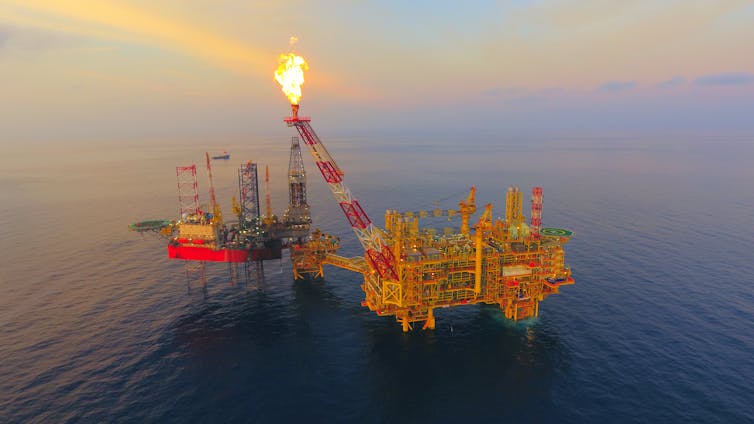
Gas flaring allows operators to alleviate pressure on equipment. AzmanMD/Shutterstock
The NSTA does estimate that an electrification campaign could save 1.2 million tonnes of CO₂ a year. That might sound like a big number, but the UK emits greenhouse gases equivalent to around 420 million tonnes of CO₂ annually. The climate benefit of the UK oil and gas industry shedding 1.2 million tonnes of CO₂ from its offshore operations amounts to just 0.3% of the country’s yearly emissions.
Cut fossil fuel use instead
I believe electrifying offshore oil and gas platforms is a wrong-headed use of taxpayer and industry money and fails to address the wider picture.
The UK would cut far more CO₂ per pound spent if the billions earmarked for offshore electrification were directed at reducing the much larger carbon footprint from fossil fuel use instead. The government could cut these emissions by improving building insulation, building more electric vehicle charging points, investing in wind and solar installations and expanding the electricity grid.
But shifting money from offshore electrification to abating fossil fuel use will not be straightforward. Perhaps the NSTA could agree to let oil and gas firms operate without electrification, provided they can demonstrate they are operating their equipment in such a way as to reduce these emissions to as low as reasonably practical. This would not cut emissions as much as electrification, but it would free up money for more effective decarbonisation elsewhere.
And in this scenario, oil and gas companies would not need to undertake open heart surgery at sea. That sounds like a win-win for everyone.







