


 Trump Eyes $54 Billion South Korean Investment in Alaska LNG
  UN Condemns Myanmar Airstrike That Kills 50 in Rakhine
  Pope Leo Urges Europe to Pursue Peace Through Compromise
  Malaysia Begins Deportation of 1,500 Myanmar Nationals
  California Bans Memecoins Issued by Public Officials Under New Law
  US Sanctions Iran Weapons Procurement Network
  Israeli Settlers Attack West Bank Village, Block Palestinian Family’s Return
  US Alcohol Ban Exposes Canada’s Internal Trade Barriers
  Second DOJ Lawyer Exits Trump Probe
  TSA Removes Chairs for Airport ID Check Officers
  UN Extends Haiti Security Force Mandate Ahead of Elections
  UK Police Probe Foreign State Link in RAF Fairford Plot
  Trump, Tech Leaders Sign ‘Morally Binding’ AI Safety Accord
  Polymarket Traders Bet on Trump AI Rename to ‘Super Intelligence’
  Senate Democrats Say Tether USDT Helps Iran Evade Sanctions
  US Appeals Court Keeps Trump IRS Case Sanctions in Place
  White House Blames Democrats as CLARITY Act Stalls


 Add as a preferred source on Google
A Trump presidency may be the right time for Australia to distance itself from the US. Reuters/Joe Skipper
To Australians, American politics can appear to be a glitzy and protracted soap opera, played out on the other side of the world with few consequences for us “down under”.
But Australians ought to be deeply concerned – for five key reasons – about Donald Trump’s seemingly unstoppable rise to be the clear frontrunner for the Republican presidential nomination.
Immigration
Australia is facing complex challenges relating to immigration and refugees. What Australia and the world urgently need is compassionate but decisive leadership that is able to manage the mass humanitarian problem with financial and cultural sensitivity.
However, while Australian politicians have often used a “dog whistle” on immigration, Trump uses a loudspeaker. He zeroed in on immigration from Mexico in June 2015:
When Mexico sends its people, they’re not sending their best … They’re sending people that have lots of problems … They’re bringing drugs. They’re bringing crime. They’re rapists.
A Trump campaign commercial claimed that, as president, he:
… will stop illegal immigrants by building a wall on our southern border that Mexico will pay for.
A Trump ad on immigration.
Following the San Bernardino terrorist attack in California last December, Trump called for:
… a total and complete shutdown of Muslims entering the United States until our county’s representatives can figure out what the hell is going on.
These statements suggest that, as president, Trump might like to see the US become more insular, to impose walls along its borders and to judge migrants on the basis of their religious beliefs.
This could matter in Australia too. Australia rightly prides itself on its peaceful multiculturalism, but its success in this area is fragile. In particular, it is threatened by fringe movements like Reclaim Australia (and pandering by mainstream politicians). Trump’s moves could embolden such movements and lend legitimacy to their aims.
Foreign and military affairs
The US is a vital strategic ally to Australia. The two countries have a long – if problematic – history of foreign policy collaboration, including joint military engagement. But they are facing two significant foreign policy challenges that require nuanced and delicate leadership – the exact opposite of Trump’s style.
In the South China Sea, China, the Philippines, Vietnam and others are locked in a dispute about who owns certain territorial waters and the resources below them. The Obama administration has taken on the role of assertive mediator and managed to prevent an escalation thus far.
For his part, Trump has made indelicate statements about China and its moves to build:
… a military island in the middle of the South China Sea.
China no doubt views such statements as provocative. But despite his concern over the South China Sea, Trump has said he wants to reduce America’s military presence in the Asia-Pacific region. That might encourage China to move ahead on its reclamation activities. It might also lead to further destabilisation if China’s rivals respond.
Any such destabilisation in the South China Sea would have serious consequences for Australia. It is not only in close proximity to Australia, but is also a major shipping route for Australian businesses. And China is Australia’s largest two-way trading partner.
The other key foreign policy challenge facing the US and Australia is their ongoing efforts to defeat Islamic State (IS) in the Middle East. Australia is a key player in President Barack Obama’s coalition to “degrade and ultimately destroy” IS.
Trump has said he:
… would knock the hell out of ISIS … when you get these terrorists, you have to take out their families.
This is a possible future president advocating war crimes. IS targets innocent women and children. The suggestion by a presidential candidate that he might do the same ought to cause international condemnation. It will certainly fuel IS’s propaganda machine.
Australia has a problematic legacy of following the US into ill-conceived wars that end in disaster. During George W. Bush’s presidency, Australia committed to military interventions in Afghanistan and Iraq. Both failed to achieve their goals and the countries remain hotbeds of violence and instability.
Trump’s preference for indiscriminate force could create a real risk that Australia is dragged into another war in the Middle East. Past experience suggests that any such war is likely to be hugely costly and difficult to “win”.
Trade and economic ties
The US is one of Australia’s largest trading partners. The Australia-US Free Trade Agreement has eliminated barriers to trade between the countries, further deepening their economic ties.
Trump, a brash New York real-estate mogul and entrepreneur, might seem like the perfect fit for a US economy still recovering from the 2007-08 global financial crisis. But appearances can be deceiving. He inherited a fortune from his father and early successes escalated his net worth.
Since then a series of failed start-ups has repeatedly crippled Trump. Overall, his business empire survives on a diet of risky investments. Economic brinksmanship may pay off for a private individual, but it is not the approach of a prudent president looking to steer a massive economy.
Some of Trump’s economic thinking was laid bare when he announced his income tax proposal. He declared that he would significantly reduce taxes for those earning under US$100,000, but left it unclear how the shortfall in revenue would be made up. The plan would reportedly cut federal revenues by $9.5 trillion over a decade, presumably leaving the states to fill this gap with new borrowing or unprecedented spending cuts.
It is easy to see why the prospect of a Trump presidency is causing alarm on Wall Street. One only has to look back at the ripple effects of the global financial crisis across Europe to see that a Trump presidency might have disastrous economic consequences for Australia.
Climate change
World leaders continue to fumble in their attempts to confront climate change. In Australia, political leadership on this issue has ranged from denying the problem exists to short-sighted election promises followed by little concerted action.
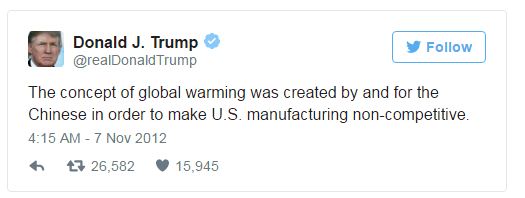
It is hard to imagine a Trump presidency that contributes positively on climate change. In one of his Twitter tirades, Trump announced:

The statement is not only offensive to the Chinese, but it flies in the face of scientific consensus that climate change is happening, and that the US is a major contributor.
Having a climate-change denier in the White House would provide a crutch for Australian politicians desperate to avoid taking decisive action on this issue.
Popularity and polarisation
The final reason Australia should worry about Trump is simply that he is so popular.
Millions of Americans back Trump despite – or perhaps because of – his style and policies. Some hold placards that say:
I’m ready to work on the wall.
Others read:
Thank you Lord Jesus for President Trump.
Trump represents, more than any other candidate, both the fears and aspirations of white working-class Americans who are exhausted by dramatic changes to their country over recent decades.
These Americans certainly want no more prudence in economic affairs and pragmatism in foreign policy. They want to call December 25 “Christmas”; they want to win wars; they want Americans to speak English. They want, in the words of Trump’s campaign slogan, to “make America great again”.
These ambitions may sound appealing, but they could lead to deeply problematic policies.
It is impossible to know for sure what a Trump presidency would be like. But there are sensible reasons to suspect it could be disastrous – not only for the US but also for Australia. A Trump presidency may prove to be a unique opportunity for Australia to carefully distance itself from the US.
 Benjamin Isakhan has received funding from the Australian Research Council and the Australian Department of Defence. The views expressed in this article are his own and unrelated to these organisations.
Zim Nwokora does not work for, consult, own shares in or receive funding from any company or organization that would benefit from this article, and has disclosed no relevant affiliations beyond the academic appointment above.
Benjamin Isakhan, Associate Professor of Politics and Policy, Deakin University
Zim Nwokora, Lecturer in Politics and Policy, Deakin University
This article was originally published on The Conversation. Read the original article.







