


 Asian Currencies Steady as Dollar Nears 18-Month High Ahead of US CPI
  FxWirePro: Daily Commodity Tracker - 21st March, 2022
  Fed's Hammack Urges Faster Rate Hikes to Fight Inflation
  Trump Defends Russian Diesel Deal Amid US Sanctions Backlash
  Nasdaq Falls as Oil Prices Surge Ahead of Bank Earnings
  China Resumes US Soybean Purchases After Trump-Xi Summit
  Oil Prices Mixed as Russia Diesel Deal and Houthi Attacks Raise Supply Concerns
  Samsung, SK Hynix Shares Plunge as China Chip Competition Grows
  Fed’s Williams Sees One More Rate Hike in 2026, None in 2027


 Add as a preferred source on Google
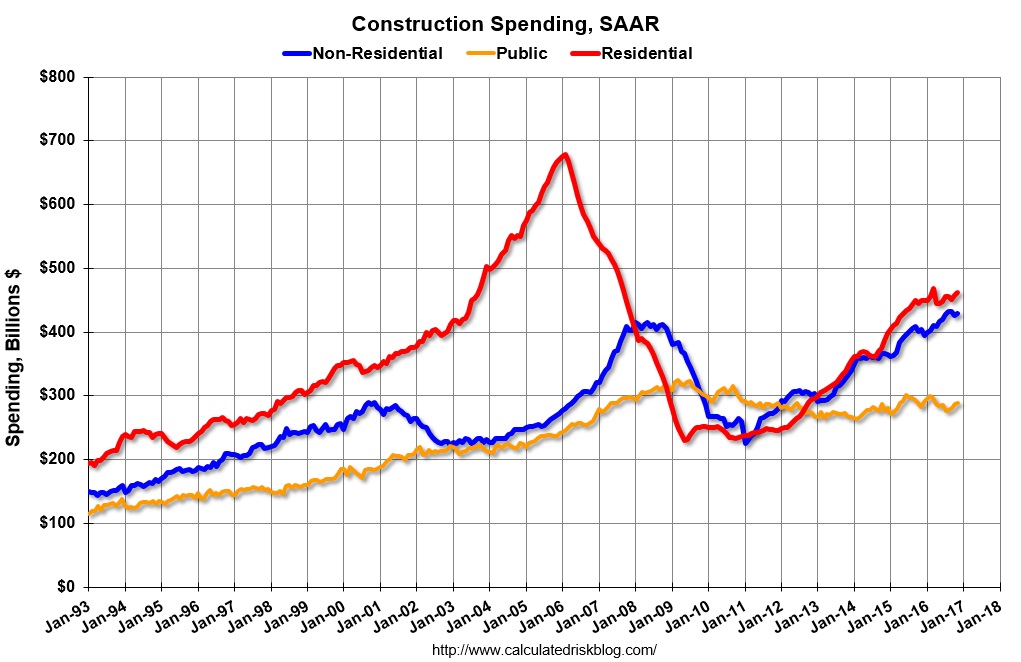
Earlier this week, US Census Bureau reported the November figure for construction spending and it showed that there was an increase in the month. The U.S. Census Bureau of the Department of Commerce announced that the construction spending during November 2016 was estimated at a seasonally adjusted annual rate of $1,182.1 billion, 0.9 percent above the revised October estimate of $1,171.4 billion. The November figure is 4.1 percent above the November 2015 estimate of $1,135.5 billion. During the first 11 months of this year, construction spending amounted to $1,070.9 billion, 4.4 percent above the $1,025.5 billion for the same period in 2015. Both private and public spending increased in November. In November, the estimated seasonally adjusted annual rate of public construction spending was $289.3 billion, 0.8 percent above the revised October estimate of $287.1 billion.
Despite a steady rise in construction spending since 2011, they remain well below the levels seen before the crisis. In 2006, the residential construction spending peaked just below $700 billion (annual rate) and now its stands just around $450 billion. Public construction spending peaked in 2009 above $300 billion but since then it has declined and remains stagnant. The newly elected President of the United States, Donald Trump has promised to ramp up the infrastructure spending and evidence of that would be found in the public construction spending component.
Chart courtesy – calculatedriskblog.com







