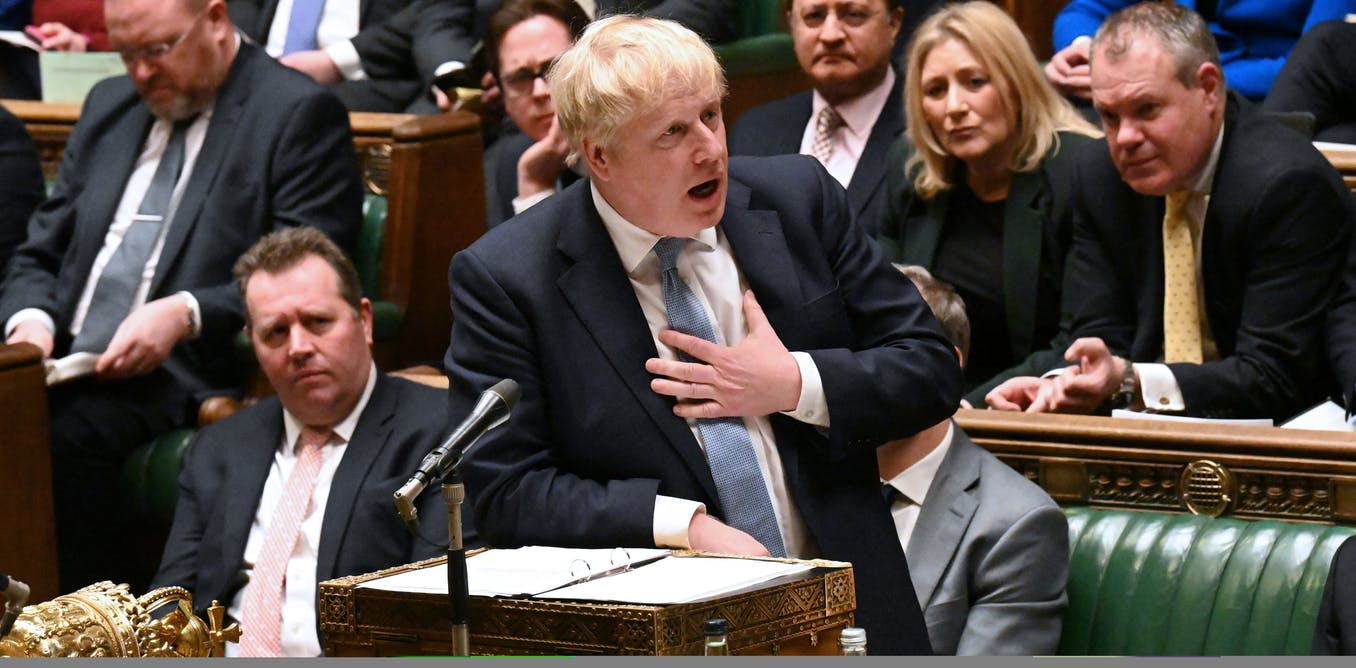
Prime Minister Boris Johnson has apologised after a report exposed failings of leadership and behaviour in Downing Street during pandemic lockdowns that was “not appropriate”. While the report was significantly shorter than had been initially expected, four takeaway points merit attention.
1. Not a full report – but significant findings
The document, published on January 31, is not the final version of the report by senior civil servant Sue Gray. That will not be published until the outcome of police investigations – and possibly not even then. However, this “update” from Gray delivers significant findings. It reveals that 16 specific incidents at Downing Street and other government buildings have been under investigation. Of these, 12 have been handed to the police after it was decided they reached the threshold for criminal investigation.
Due to this police involvement, Gray did not provide detailed factual accounts of the events themselves. Nor did she name anyone specifically. But, having interviewed over 70 individuals, and analysed a range of documents and digital information, she concluded that “some of the behaviour surrounding these gatherings is difficult to justify”.
She cited “failures in leadership and judgment by different parts of Number 10 and the Cabinet Office” and warned there was a lack of “clear authorisation or oversight” regarding the use of the Downing Street garden for gatherings. Staff wishing to raise concerns about work behaviours “at times felt unable to do so”.
Gray highlighted the “excessive consumption of alcohol” as an example of serious failures to observe professional standards expected in government at any time – as well as the standards being enforced on the wider public during the pandemic, via regulations.
2. The ticking time bomb has been diffused – for the time being
Johnson’s strategy on receipt of the Gray “update” was to apologise in parliament, commit to organisational reforms at Number 10 – and refuse to answer detailed questions about his own involvement in any of the events, pending the outcome of the police inquiries.
Gray has proposed a significant reform agenda, involving a restructuring of the Downing Street operation. Johnson embraced Gray’s ideas, committing to set up a new Office of the Prime Minister, and review the civil service and special adviser codes of conduct. His political instincts were in evidence here and he showed a willingness to make immediate organisational changes without committing to disciplinary sanctions against individual culprits.
The opposition parties in parliament and and some of Johnson’s own Conservative MPs continued to call for the prime minister’s resignation, focusing on his own alleged attendance at some of the events and his failure to provide appropriate leadership.
A key theme here has been the apparent contradictions between Johnson’s various statements to the House of Commons about the alleged events, and also his vagueness regarding publication of a full version of Gray’s report. In maintaining focus on these points in particular, Johnson’s critics are implying that he has broken the ministerial code and lied to the Commons – normally a resigning offence.
Johnson’s immediate future hinged on the extent to which his own parliamentary party would continue to support him. Several senior Conservatives, including the former prime minister Theresa May, criticised Johnson in the House of Commons, but the trigger for any serious threat to Johnson’s position is the submission of at least 54 letters of no confidence from MPs to the leader of the party’s parliamentary caucus.
At no point during the past few weeks of crisis has that number been reached. Importantly, reports from the meeting of the Conservative parliamentarians held a few hours after Johnson’s statement on Gray indicated that he retained enough support to survive, at least for now. It remains to be seen how this support will hold up once the police report on their investigations, and once the public have a chance to deliver an electoral verdict on Johnson’s performance in local elections this spring.
3. An accountability vacuum has been identified
Debates about Gray’s role and remit, and the limitations of her report have raised questions about the UK’s complex system for overseeing standards of conduct in public life. The Gray inquiry can be viewed as one of the occasional ad-hoc devices deployed, amid a confusing nexus of parliamentary and non-parliamentary committees, and government advisers, all with different powers and remits and varying degrees of independence.
This system raises serious issues concerning accountability gaps and vacuums. The final report was filed to Johnson himself and Gray lacked powers to enforce recommendations. The decision to delay publication of the final report and produce an “update” pending the outcome of police investigations added to the sense of unease.
All of this might be seen as abstract and academic were it not for the fact that public attention has been gripped by the issues here. Allegations about rule-breaking, illicit partying and drinking during a national crisis have focused attention on the limitations of the systems for accessing information and delivering accountability in government.
4. There’s more to come – but we don’t know when
Once it was revealed that Gray’s report would be severely diluted because she could not reveal details about the 12 events under police investigation, many decided it would inevitably prove a damp squib. Others still held out hope for a blockbuster report that would force major change and even a resignation from Johnson.
The immediate outcome falls into neither category. But despite the limitations placed on Gray, her findings present a damning indictment of standards of conduct and the operational culture at the heart of British government during the lockdown phases of the COVID-19 pandemic.
They pose serious questions for the prime minister and the leadership of the civil service but, for now, Johnson is able to fall back on the ongoing police investigation to continue to avoid answering some of the difficult questions. Much will hinge on the outcome of those investigations, and the final version of Gray’s report – if it is ever published.