


 Urban studies: Doing research when every city is different
  European Stocks Rally on Chinese Growth and Mining Merger Speculation
  Mexico's Undervalued Equity Market Offers Long-Term Investment Potential
  UBS Projects Mixed Market Outlook for 2025 Amid Trump Policy Uncertainty
  Gold Prices Fall Amid Rate Jitters; Copper Steady as China Stimulus Eyed
  China's Refining Industry Faces Major Shakeup Amid Challenges
  UBS Predicts Potential Fed Rate Cut Amid Strong US Economic Data
  Bank of America Posts Strong Q4 2024 Results, Shares Rise
  Gold Prices Slide as Rate Cut Prospects Diminish; Copper Gains on China Stimulus Hopes
  Geopolitical Shocks That Could Reshape Financial Markets in 2025
  Oil Prices Dip Slightly Amid Focus on Russian Sanctions and U.S. Inflation Data
  Stock Futures Dip as Investors Await Key Payrolls Data
  US Futures Rise as Investors Eye Earnings, Inflation Data, and Wildfire Impacts
  Moody's Upgrades Argentina's Credit Rating Amid Economic Reforms
  U.S. Stocks vs. Bonds: Are Diverging Valuations Signaling a Shift?
  Global Markets React to Strong U.S. Jobs Data and Rising Yields


 Add as a preferred source on Google
The weakness in Asian markets is likely to filter through to other markets as investors digest China’s downwardly-revised growth target setting risk assets on the back foot. In addition, the US Trade Representative office announced that India and Turkey no longer qualified as beneficiary developing countries under Washington’s Generalized System of Preferences (GSP). The GSP provides low-income and emerging economies with duty-free access to the US market for some of their exports. This is likely to stoke trade tensions and weigh on emerging-market currencies.
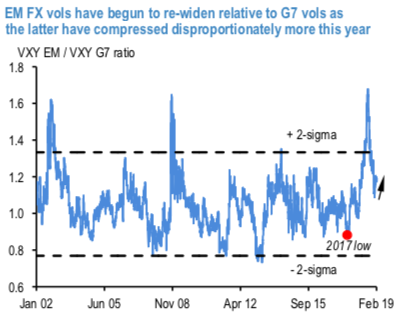
An odd by-product of the nosedive in G7 vol has emerged: EM vs. G7 vol spreads are re-widening, not because risk premia in EM are rising as was the case last year – quite the opposite in fact – but because G7 options have cheapened disproportionately more (refer 1st chart).
Rewards from outright vol selling are absolute, not relative quantities, yet this comparative EM – G7 vol set-up is motivating many to consider short EM FX vol plays as a complement to long carry portfolios. One cannot argue with a theme that is so manifestly working – 2nd chart exhibits that traditional high-beta EM names like TRY, MXN and KRW led the short vol league tables in February with sizeable 1.5 – 3.0 % pt. P/Ls, in contrast to mild losses from selling AUD and NZD vol where central bank and data-driven spot gyrations were more acute.
We ourselves are running short TRY and MXN vol in our model portfolio in more cautious formats than outright straddles (TRY – ratio USD put/TRY call spreads; MXN – calendar risk-reversals). TRY in particular offers above-average vol risk premium to monetize (1M ATM 13.0 vs. trailing 1m realized vol 8.0); we think implied vols are being kept artificially elevated by macro demand for directional carry- earning purchased option structures (USD puts/put spreads/digitals), but the historical track records of cash FX carry versus vol carry in the lira are so starkly divergent (refer 3rd chart) that we think levered money will be drawn to the latter sooner or later, which in turn should pressure vol lower.
In terms of the rest of our USD/Asia profile, the revised CNY outlook shifts other EM Asia currencies higher, particularly in the second half of 2019. However, the broad pattern of current account surplus currencies outperforming those with current account deficits is maintained. Courtesy: RMB & JPM
Currency Strength Index: FxWirePro's hourly CAD spot index is flashing at -129 levels (which is highly bearish), hourly USD spot index was at 103 (highly bullish), EUR is at -55 (bearish) and GBP is at -64 (bearish) while articulating at (08:22 GMT). These indices are indicating the CAD’s softness against majors.
For more details on the index, please refer below weblink: http://www.fxwirepro.com/currencyindex







