


 Urban studies: Doing research when every city is different
  Geopolitical Shocks That Could Reshape Financial Markets in 2025
  Oil Prices Dip Slightly Amid Focus on Russian Sanctions and U.S. Inflation Data
  UBS Projects Mixed Market Outlook for 2025 Amid Trump Policy Uncertainty
  Stock Futures Dip as Investors Await Key Payrolls Data
  Gold Prices Slide as Rate Cut Prospects Diminish; Copper Gains on China Stimulus Hopes
  Gold Prices Fall Amid Rate Jitters; Copper Steady as China Stimulus Eyed
  Goldman Predicts 50% Odds of 10% U.S. Tariff on Copper by Q1 Close
  Moldova Criticizes Russia Amid Transdniestria Energy Crisis
  U.S. Treasury Yields Expected to Decline Amid Cooling Economic Pressures
  Wall Street Analysts Weigh in on Latest NFP Data
  Energy Sector Outlook 2025: AI's Role and Market Dynamics
  European Stocks Rally on Chinese Growth and Mining Merger Speculation
  U.S. Stocks vs. Bonds: Are Diverging Valuations Signaling a Shift?
  Trump’s "Shock and Awe" Agenda: Executive Orders from Day One
  Lithium Market Poised for Recovery Amid Supply Cuts and Rising Demand
  Bank of America Posts Strong Q4 2024 Results, Shares Rise


 Add as a preferred source on Google
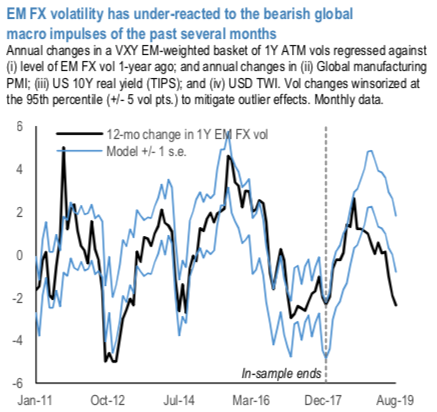
EMFX volatility has under-reacted to the deterioration in global manufacturing and the attendant tightening in financial conditions YTD. Severe undervaluation of volatility has been a persistent feature of currency markets this year that has only recently begun to respond to the worsening in the global risk backdrop after the break of 7.0 on USDCNY in early August.
This corrective process has a long runway, in large part because we estimate
that VXY Global has to climb 2.5 % pts. merely to eliminate its cyclical cheapness, let alone factoring in any additional risk premium under stress.
As was the case in 2018, EMFX volatility may well lead this re-pricing because US dollar strength accompanying the ongoing slump in global growth has diametrically opposite effects on monetary conditions in advanced and emerging economies. Unlike in DMs where USD strength / FX weakness loosens financial conditions – often in cahoots with easier monetary policy (c.f. RBA and RBNZ this year) – and helps alleviate domestic slowdowns, EMEs conversely experience a tightening of monetary and credit conditions due to increased debt-servicing pressures on corporates with foreign currency liabilities and foreign ownership of local currency bond market that is prone to retrenchment. It is a little surprising then that EM FX vols have under-reacted so severely to the bearish global impulses that have been in train all year. The net outcome of the drop in Global PMI (vol +ve), USD TWI strength (vol +ve) and fall in US real yields (vol -ve) should have been to push a VXY-EM weighted basket of 1Y ATM vols 0.5 %pts. higher y/y (-0.8 to +1.8 the +/- 1 s.e. range); the actual outturn has been a 2.3 vol pt. decline.
The degree of this under-reaction looks even more severe if TRY is excluded from the EM basket on grounds that last year’s sell-off in the lira is too extreme a template to judge other EMs, since it further weakens any justification for mean- reversion lower in vol from 3Q’18’s elevated levels. The cheapness of EM FX vol is especially pronounced in longer expiries (1Y) given the flatness of EM vol curves. The 1Y – 1M VXY EM vol curve is currently almost flat, which has typically not proved a sustainable state of affairs: either curves have to invert at higher vol levels amid FX stress, or markets drift into a pocket of calm that pulls the front-end lower and steepens term structures.
We judge that the former is more likely in coming months, in part because of initial conditions on valuations as outlined earlier, and partly because long-end vols and vol curves have not priced in the accelerated de-coupling of US Treasury yields and the US dollar recently. Courtesy: JPM







