


 Mexico's Undervalued Equity Market Offers Long-Term Investment Potential
  Wall Street Analysts Weigh in on Latest NFP Data
  Indonesia Surprises Markets with Interest Rate Cut Amid Currency Pressure
  UBS Projects Mixed Market Outlook for 2025 Amid Trump Policy Uncertainty
  Geopolitical Shocks That Could Reshape Financial Markets in 2025
  Global Markets React to Strong U.S. Jobs Data and Rising Yields
  China's Refining Industry Faces Major Shakeup Amid Challenges
  Trump’s "Shock and Awe" Agenda: Executive Orders from Day One
  Stock Futures Dip as Investors Await Key Payrolls Data
  Moody's Upgrades Argentina's Credit Rating Amid Economic Reforms
  Moldova Criticizes Russia Amid Transdniestria Energy Crisis
  Gold Prices Slide as Rate Cut Prospects Diminish; Copper Gains on China Stimulus Hopes
  US Futures Rise as Investors Eye Earnings, Inflation Data, and Wildfire Impacts
  Fed May Resume Rate Hikes: BofA Analysts Outline Key Scenarios
  Energy Sector Outlook 2025: AI's Role and Market Dynamics
  S&P 500 Relies on Tech for Growth in Q4 2024, Says Barclays
  U.S. Banks Report Strong Q4 Profits Amid Investment Banking Surge


 Add as a preferred source on Google
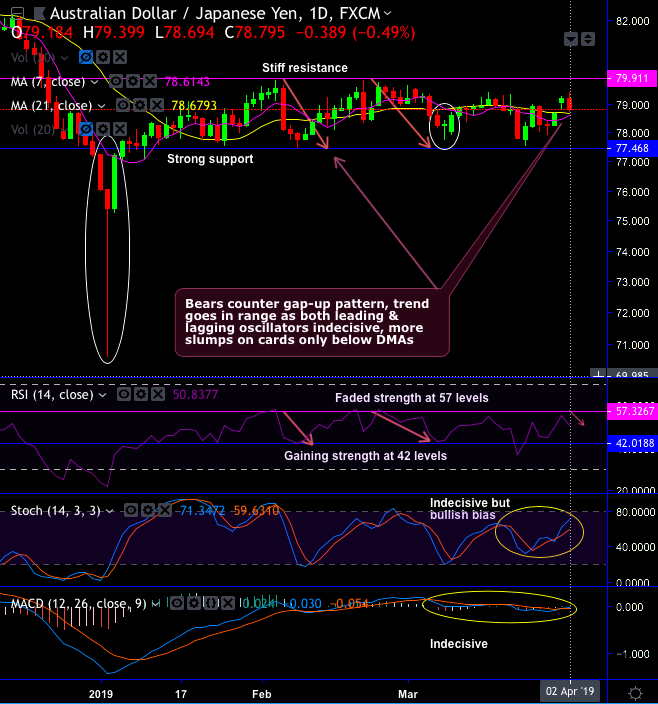
- The recent rally in AUDJPY has largely been driven by a stronger USDJPY and in the short term, this strength is starting to look exhausted.
- Profit taking by Japanese investors, a flatter curve in the US, or a rise in equity market volatility could all be catalysts for the reversal.
- Risk/reward favors selling AUDJPY at 79.445 with a stop above the range high at 79.911 and a target of 77.254 level.
Although fundamentals (commodity prices and interest rates) argue the cross should be higher, global risks plus mixed AU economic data plus AU political risks are headwinds. We forecast the RBA will cut twice in 2019, the cross is likely to remain below 77.254 level.
It is reckoned that there are a couple of different triggers that can make this trade work.
First, the steepening that we have seen in the US curve since September has been very sharp, and while we think it is sustainable over the medium term, in the short term we would not be surprised to see some consolidation. Should this occur, the JPY would likely be the biggest beneficiary given its recent performance. As such, a flatter US curve would likely drive a depreciation in AUDJPY.
By the same token, a further steepening also adds to the downside risk to the AUDJPY. If the curve steepened further, there is some risk that the stellar run that we have seen in equity markets could become unhinged by a higher cost of funds. Once again, if this were the case, we would see broader market volatility rising, and as a result, AUDJPY underperforming.
Over and above this, in terms of timing, the rise in the FX cross rate typically elicits behaviour from Japanese investors that sees either profit taking (given the unhedged nature of Japanese flows into AUD) or for those still accumulating AUD cash – brings about a bigger usage of JGB cross-currency asset swap trades rather than cash bond buying.
Note also that the AUDJPY touched the mid-80s a number of times this year and was followed by steep falls. We would expect to see Japanese investors selling bonds at this level, having seen a sharp appreciation in FX terms, and in recent days a rally in bond markets.
Finally, in the event of a broader USD sell-off, we think the AUD will underperform other crosses. Both iron ore and coal prices are now sitting well above ANZ forecasts, and as such we see limited further upside. In addition, RBA pricing for 2017 is also providing very limited room for a substantial sell-off at the short end of the curve, so this too should limit the AUD’s performance.
On hedging grounds, we advocate initiating shorts in AUDJPY futures contracts of May’19 delivery as further downside risks are foreseen.
Furthermore, we advocate adding longs in a 3m AUDJPY ATM put, spot reference: 78.885, short a 3m AUDJPY OTM calls also (with strikes at 81.00).
Alternatively, short AUDJPY in cash at 79.166 levels, stop 79.911 levels. Courtesy: ANZ
Currency Strength Index: FxWirePro's hourly AUD spot index is flashing at 14 (which is mildly bullish), hourly JPY is at -76 (bearish) while articulating at (11:23 GMT).
For more details on the index, please refer below weblink: http://www.fxwirepro.com/currencyindex







