


 Ethereum Price Drops Below $2,600 as Long Liquidations Hit 4-Month High
  RBI Uses $10 Billion Currency Swaps to Drain Excess Rupee Liquidity
  Zcash Privacy Demand Rises as AI Exposes Bitcoin Transactions
  Cardano Price Eyes $0.30 as ADA Whale Activity Surges
  Circle Stock Falls 4% as Crypto Selloff Overshadows SAP Pay Expansion
  Fed Unveils Stablecoin Rules Under GENIUS Act
  Fed’s Williams Signals One More Rate Hike Before Year-End
  Bitcoin Outflows From Binance Hit Three-Year High as Whales Accumulate
  BlackRock’s Rick Rieder Favors Bonds Over Stocks as Treasury Yields Surge
  Yen in Focus as BOJ, Fed Rate Hikes Reshape Currency Markets
  RBI Raises Repo Rate to 5.50% in Hawkish Shift on Inflation Risks
  RBA Hikes Interest Rate to 4.60% as Inflation Risks Rise
  Litecoin Marks 15 Years as Grayscale Backs LTC ETF Push
  Zcash Mining Profits Surge as Liquidity Risks Grow


 Add as a preferred source on Google
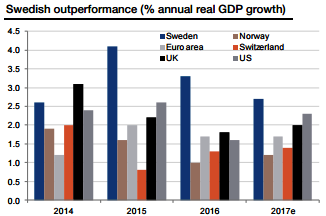
The April inflation data release out of Sweden reinforced our bullish medium-term view of the Swedish krona. With the Frexit risk evaporating with Macron's victory in the French presidential election, the market focus is increasingly turning to the potential for monetary policy shifts in Western Europe, particularly towards tightening.
The Swedish economy has been performing well for some time now, but the Riksbank has kept its dovish policy bias, given its lack of confidence about the durability of the reflation trend in the country (refer above chart).
This caution was not unwarranted, as we have seen how stronger growth has not translated into much higher inflation pressures outside Sweden. Moreover, the Riksbank has its own bitter experience from 2011-12, when headline CPI toppled from 3% to under 0% in a span of 15 months.
Growth and inflation data remain at odds in Sweden. Growth has been running at 4% annualized pace for the last two-quarters and the manufacturing PMI is the highest globally at a heady 65.2 (services at 61.3), yet the primary preoccupation of the Riksbank — inflation — has disappointed yet again.
In addition, an outcome for the French elections in line with our base case could result in modest EUR strength. To cushion against these moves we recommend raising the stop-out level on EURSEK by 0.55. Short NZDSEK through a put has underperformed substantially.
With a month left to expiry, we look for opportunities to unwind this trade.
Sold EURSEK at 9.4847 on January 13. Marked at -1.68%.
Long a NZD put/SEK call, strike 6.10, expiry May 23. Paid 1.47%, marked at 0.22%.







