


 Moldova Criticizes Russia Amid Transdniestria Energy Crisis
  Kazakhstan and Tether Explore Tenge Stablecoin and RWA Tokenization
  Evernorth XRPN Nasdaq Listing Delayed to October 12
  Circle Stock Falls 4% as Crypto Selloff Overshadows SAP Pay Expansion
  Jameson Lopp Downplays AI Threat to Bitcoin Cryptography
  XRP Whale Activity Drops 27% in Eight Days Amid Market Sell-Off
  Lithium Market Poised for Recovery Amid Supply Cuts and Rising Demand
  Bitmine to Stop Ethereum Buying After Reaching 5% ETH Supply
  Bank of America Posts Strong Q4 2024 Results, Shares Rise
  Goldman Predicts 50% Odds of 10% U.S. Tariff on Copper by Q1 Close
  Crypto Liquidation Flush: BTC & ETH at a Glance
  US Government Moves $1 Billion in Bitcoin Amid Sale Speculation
  U.S. Treasury Yields Expected to Decline Amid Cooling Economic Pressures


 Add as a preferred source on Google
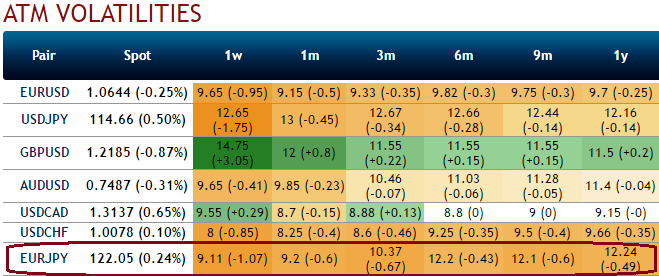
The EUR/JPY volatility surface is offering very attractive opportunities because the skew on the 6m and 1y is currently excessive (refer 4th graph). Where IV skews seem to be mispricing, which is why implied vols of this pair across the various tenors are reducing considerably.
If we’ve to contemplate that the options market is pricing EURJPY risk reversals (RR) as the sum of EUR/USD and USD/JPY RR, the triangle is perfectly priced (refer 2nd graph). The implied volatility of 6m and 1y 25-delta strikes is trading about 3 volatility points higher than ATM volatility, which supposes that the implied volatility should be strongly negatively correlated with the FX rate.
Since 2013, the EURJPY RR has strongly mean reverted towards the vol/spot correlation. However, this correlation has been about zero for a few weeks (refer 3rd graph), such that EURJPY 6m skew is now disconnected from its fair value.
Splitting the EURJPY RR into EURUSD and USDJPY components, like the market, exhibits the source of this mispricing. The EURUSD 6m RR is trading at -1.8 and the USD/JPY at -1.1. The former is consistent with the EURUSD price action, which actually saw downside volatility.
However, USDJPY has indeed been positively correlated with its volatility, hence the EURJPY mispricing comes from the yen side. Investors could directly consider selling the USDJPY excessive skew, but we recommend selling the EURJPY skew instead. It offers a larger risk premium (due to the fairly priced EURUSD smile component), which is opportunistic given our bullish bias on the spot.







