


 Cardano Price Drops 15% as Whales Sell 110 Million ADA
  Ripple-Backed Evernorth Set for Nasdaq Debut With 473 Million XRP
  U.S. Treasury Yields Expected to Decline Amid Cooling Economic Pressures
  Crypto Derivatives Dashboard: Bulls Retain Control Amid $488M Liquidation Flush
  Trump’s "Shock and Awe" Agenda: Executive Orders from Day One
  Global Markets React to Strong U.S. Jobs Data and Rising Yields
  US Gas Market Poised for Supercycle: Bernstein Analysts
  Bank of America Posts Strong Q4 2024 Results, Shares Rise
  UBS Predicts Potential Fed Rate Cut Amid Strong US Economic Data
  Zcash Price Drops 30% as ZEC Tests Critical $1,120 Support
  Arthur Hayes Announces FLOP Testnet Launch Within Weeks
  Gold Prices Fall Amid Rate Jitters; Copper Steady as China Stimulus Eyed
  Hyperliquid (HYPE) Price Analysis: Can Bulls Push Above $88?
  Dogecoin Price Rebounds as DOGE Defends $0.08 Support
  Hong Kong’s Second Solana ETF Launches With Lower Fees


 Add as a preferred source on Google
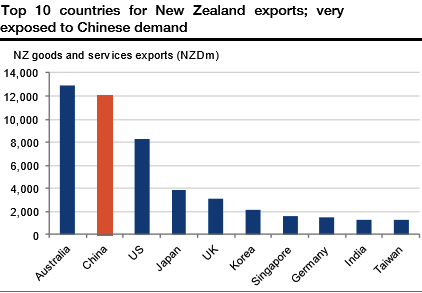
Fading Chinese growth and commodity prices remain a major risk for commodity currencies. More specifically, China remains the second destination for NZ exports, just after Australia and before the US. Any slowdown in Chinese demand will weigh on NZ growth and reduce the inflows, therefore weighing on the currency. We expect NZDUSD to fall to 0.64 by end-2017.
Downside medium-term kiwi volatility is expensive if we consider that NZDUSD 1y implied volatility rose above 12 while 3m realized volatility sharply fell after the summer to return to around 10. Since June, NZDUSD has been trading in the 0.70-0.74 range after a bullish first semester. We expect the down move to be relatively slow next year, and in any case, it is unlikely to lift implied volatility even higher compared to the mild spot dynamics. The skew is also decisively oriented towards dollar puts, such that the volatility picture suggests selling the kiwi via RKO puts.
We expect the NZD to fall the most against the USD in 2017, reaching 0.64 by year-end. New Zealand remains highly exposed to a slowdown in Chinese demand, and the RBNZ won’t stay neutral in front of revived currency strength. Short rates already point toward a much lower NZDUSD. Downside medium-term kiwi volatility is expensive, suggesting RKO puts. Buy NZDUSD 1y put strike 0.68 RKO 0.59 for 0.98% (spot ref: 0.6997), which compares with 3.85% for the vanilla.
We recommend buying a NZDUSD 1y put with a strike at 0.68, just below the 0.70 resistance, and an American knock-out barrier at 0.59, just below the 0.60 psychological support and five figures below our end-2017 forecast of 0.64. This trade embeds negative convexity and is therefore purely buy-and-hold since the potential leverage cannot be monetized before the expiry. The advantage is that the risk is limited to the premium paid, an attractive feature for a cheap short volatility trade, costing less than a third of the equivalent vanilla.







