


 Oil Prices Dip Slightly Amid Focus on Russian Sanctions and U.S. Inflation Data
  Gold Prices Rebound as Dollar Weakens Ahead of US Inflation Data
  Hyperliquid (HYPE) Price Analysis: Can Bulls Push Above $88?
  Gold Prices Mixed Ahead of US Inflation Data and Fed Rate Outlook
  Crypto Derivatives Dashboard: Bulls Retain Control Amid $488M Liquidation Flush
  U.S. Treasury Yields Expected to Decline Amid Cooling Economic Pressures
  US Futures Rise as Investors Eye Earnings, Inflation Data, and Wildfire Impacts
  Philippines Current Account Deficit Seen at $19.1 Billion in 2026
  Cardano Price Drops 15% as Whales Sell 110 Million ADA
  Nasdaq Faces Pullback to 26,225 Despite Bullish Outlook, UBS Says
  Gold Prices Slide as Rate Cut Prospects Diminish; Copper Gains on China Stimulus Hopes
  DeFi Development Adds 22,070 SOL to Solana Treasury
  S&P 500 Relies on Tech for Growth in Q4 2024, Says Barclays
  Moldova Criticizes Russia Amid Transdniestria Energy Crisis
  Bitcoin Price Faces Volatility Ahead of US CPI and Fed Speech
  UK Finance Minister Healey Calls for Fiscal Discipline Amid Global Risks
  Oil Prices Fall as Russia Signals Higher Diesel Exports


 Add as a preferred source on Google
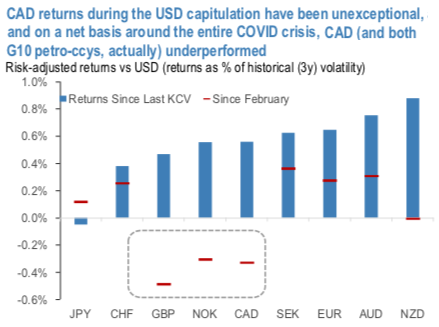
USDCAD has fallen a sizable 4% since our last publication, but this is reflective entirely of the broad dollar’s anti-cyclical properties and negative beta to risk, and is not indicative of outright CAD outperformance. CAD headwinds bias our USDCAD forecasts higher over the medium-term. In some ways, that CAD has only depreciated 2.2% on net against the dollar since March despite the intervening pandemic-led global recession, Saudi-Russo price war, briefly-negative oil prices, and the single greatest Canadian economic & labor market shock ever is remarkable. But this is indicative more of the recent market paradigm shift around risky markets and the USD which has whole-heartedly embraced of the reopening of global economies and the attendant bounce-back in growth, despite the fact that global benchmark oil levels are still 25-30% below pre-crisis levels and US & Canadian unemployment could remain above 10% of the remainder of the year. Indeed, despite USDCAD touching 1.33 and dropping 6.5% total since mid-March, CAD is unexceptional when compared against other G10 currencies this month and, against pre-COVID levels, CAD is actually a relative laggard in G10 (refer above chart).
Thus, despite recent USDCAD weakness, we continue to harbor reservations about the prospects of CAD’s resilience this year, but believe this pessimism is better expressed tactically through crosses than versus the USD as the latter continues to consolidate in the pro-growth environment and as CAD remains well-correlated with riskier assets.
Trading tips: At spot reference: 1.3653 levels (while articulating), one-touch call options strategy is advocated using upper strikes at 1.38 levels. One can see exponential yields as the underlying spot FX keeps spiking towards upper strike on the expiration.
Alternatively, we recommended directional hedges that comprised of longs in USDCAD futures contracts of July’20 delivery, simultaneously, shorts in futures of June’20 delivery. The short leg has delivered desirable hedging objectives so far due to the price dips in the recent past. While long leg of July tenor should be upheld with an objective of arresting potential bullish risks.







