


 Cardano Hits Five-Year Transaction Record as ADA Price Falls
  Mexico's Undervalued Equity Market Offers Long-Term Investment Potential
  Cardano Price Drops 15% as Whales Sell 110 Million ADA
  Bitcoin Price Faces Volatility Ahead of US CPI and Fed Speech
  DeFi Development Adds 22,070 SOL to Solana Treasury
  Goldman Predicts 50% Odds of 10% U.S. Tariff on Copper by Q1 Close
  Most Americans Oppose Election Betting on Prediction Markets, Poll Finds
  Nasdaq Faces Pullback to 26,225 Despite Bullish Outlook, UBS Says
  Bank of America Posts Strong Q4 2024 Results, Shares Rise
  Moldova Criticizes Russia Amid Transdniestria Energy Crisis
  China’s Growth Faces Structural Challenges Amid Doubts Over Data
  Stock Futures Dip as Investors Await Key Payrolls Data
  US Futures Rise as Investors Eye Earnings, Inflation Data, and Wildfire Impacts
  Morgan Stanley Predicts $10 Trillion RWA Market by 2030
  Ripple Mints 19.6 Million RLUSD Amid Banking Expansion
  UBS Projects Mixed Market Outlook for 2025 Amid Trump Policy Uncertainty


 Add as a preferred source on Google
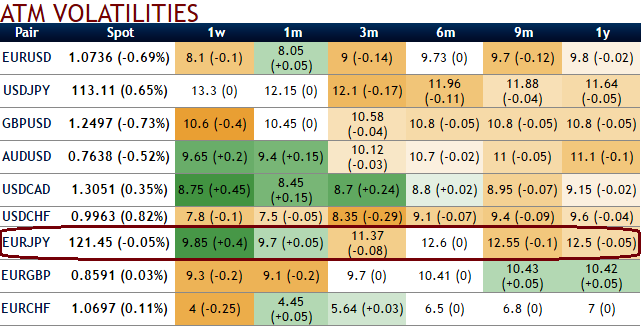
The EURJPY volatility surface is currently offering very attractive shorting opportunities, as ATM volatility is rich and 6m/1y skews are excessively priced. Here, we recommend a couple of trades taking advantage of both the volatility and skew premiums.
In the volatility space, going short a 6m variance swap provides extremely high-profit odds. EURJPY 6m realized volatility has spent 78% and 89% of the time below the current variance swap bid level since 2007 and 2011 respectively.
We keep our EURJPY bullish bias as a directional reflation trade, which can be advantageously expressed via a zero-cost 6m topside seagull strikes 114/123.5/128.
Volatility trade: go short EURJPY 6m variance swap @14.3 (EUR indicative bid).
Trade risks: 6m realized volatility below 14.3 in 6m. Investors receive or pay the squared difference between the 14.3 strike and the terminal realized volatility and face unlimited losses if realized volatility is beyond this strike level.
Directional trade: Buy EURJPY 6m topside seagull strikes 114/123.5/128 Zero cost (indicative offer, spot ref: 123.1715).
Trade risks: unlimited below 114. The structure is buying a standard call spread strikes 123.5/118 fully financed by selling a put strike 114. As such, investors face unlimited downside risk at the expiry if EURJPY trades below 114.







