


 Lithium Market Poised for Recovery Amid Supply Cuts and Rising Demand
  Fed Unveils Stablecoin Rules Under GENIUS Act
  Fed May Resume Rate Hikes: BofA Analysts Outline Key Scenarios
  2025 Market Outlook: Key January Events to Watch
  Yen in Focus as BOJ, Fed Rate Hikes Reshape Currency Markets
  Trump Demands Powell Resign Over Fed Renovation Cost Overruns
  Global Markets React to Strong U.S. Jobs Data and Rising Yields
  ECB May Stop Rate Hikes After December, Capital Economics Says
  US Futures Rise as Investors Eye Earnings, Inflation Data, and Wildfire Impacts
  China’s Growth Faces Structural Challenges Amid Doubts Over Data
  U.S. Treasury Yields Expected to Decline Amid Cooling Economic Pressures
  China's Refining Industry Faces Major Shakeup Amid Challenges


 – Use USD/ZAR DCS for hedging - EconoTimes)


 Add as a preferred source on Google
The most recent South African economic data was not exactly constructive: the unemployment rate rose to over 27% in Q3 and the inflation rate also rose to 6.4% in October. That means it has eased only slightly against its high in February of 7% and remains stubbornly above the central bank’s target corridor of 3-6%.
The South African Reserve Bank left its benchmark repo rate on hold at 7 pct at its November of 2016 meeting, as widely expected.
Policymakers said growth in the third quarter is expected to be positive, but below the level of June quarter, while left the GDP forecasts unchanged from September. The inflation reached to an 8-month high in October, after food prices picked up the most since 2009 due to severe drought, but it is expected to moderate in early 2017.
The bank also noted the rand will be sensitive to changes in the stance of the US monetary policy.
The central bank (SARB) now seems to be increasingly stuck between a rock and a hard place in the shape of the weak economic data on the one hand and the increased depreciation pressure on the rand on the other.
After all, in its October report, it expected the rate of inflation to return into the target corridor in the second quarter of 2017.
However, the biggest risk in this context is the rand. In addition to global factors, it is mainly the political uncertainty in South Africa that is putting pressure on the rand as well as the risk of a rating downgrade.
We firmly maintain our bearish stance in ZAR, with the South African rand screening as exorbitantly priced versus the dollar, even as the domestic political story has suffered a meaningful shift. The rand now appears to be pricing in “positive" political risk premium, as recent events have weakened President Zuma’s position and increased the chances of a “regime change”.
The current market price action differs from previous political episodes, where USDZAR has frequently priced negative political risk premium related to risks that Finance Minister Gordhan could be dismissed.
FX Option Strategy - Diagonal Call Spreads (DCS):
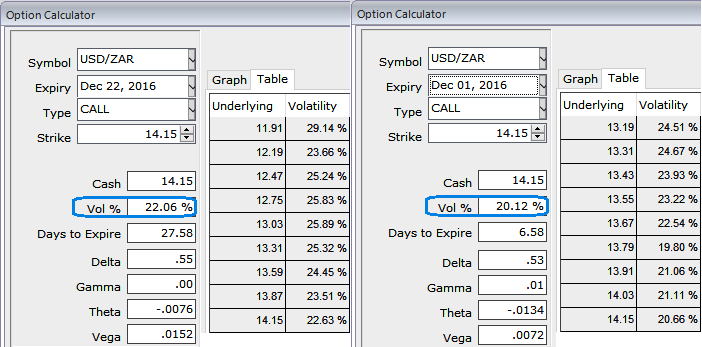
Hence, we upheld the long positions in USDZAR in option spreads, cash trades were not preferred on account of high yield IVs, 1m ATM IVs are spiking shy above 22% from 20% in 1w tenor which is a good sign for option holders.
Anticipating further price upswings in the underlying spot of USDZAR, on hedging front, we recommend positioning long USDZAR (ZAR has been significantly overshooting fundamentals), which makes buying USDZAR vol all the more appealing.
In a naked vanilla form, we suggest credit call spreads types at the 1M horizon but with a diagonal tenor pattern, optimizing strikes for leverage. In USDZAR, the 1M-2MATM spread is below average at +0.75, as 1M vols had remained relatively anchored and never softened significantly. One could initiate their option trades as shown in the diagram, but use appropriate strikes and tenors as per the requirements.







