


 Moody's Upgrades Argentina's Credit Rating Amid Economic Reforms
  Trump’s "Shock and Awe" Agenda: Executive Orders from Day One
  Goldman Predicts 50% Odds of 10% U.S. Tariff on Copper by Q1 Close
  Wall Street Analysts Weigh in on Latest NFP Data
  2025 Market Outlook: Key January Events to Watch
  U.S. Stocks vs. Bonds: Are Diverging Valuations Signaling a Shift?
  Gold Prices Fall Amid Rate Jitters; Copper Steady as China Stimulus Eyed
  Stock Futures Dip as Investors Await Key Payrolls Data
  Oil Prices Dip Slightly Amid Focus on Russian Sanctions and U.S. Inflation Data
  US Gas Market Poised for Supercycle: Bernstein Analysts
  Moldova Criticizes Russia Amid Transdniestria Energy Crisis
  Gold Prices Slide as Rate Cut Prospects Diminish; Copper Gains on China Stimulus Hopes
  Indonesia Surprises Markets with Interest Rate Cut Amid Currency Pressure
  Bank of America Posts Strong Q4 2024 Results, Shares Rise
  Energy Sector Outlook 2025: AI's Role and Market Dynamics
  Geopolitical Shocks That Could Reshape Financial Markets in 2025
  Urban studies: Doing research when every city is different


 Add as a preferred source on Google
The FX volatility market has so far in 2019 failed to display any material inversion of the bearish trend started in mid- 2016. Most of the 0.7 vols rise in the J.P. Morgan VXY G7 Index since mid-July can be attributed to the Brexit risk premium impacting cable’s vol, whereas the EM Index, at present just 0.7 vols above the DM one, has continued a steady drop. A few weeks ago we had pointed out to synchronous dovish-sounding Central Banks as a key factor in keeping vol levels suppressed contemplating assessment of the impact of rates correlations on FX vols by JPM analysts. A less dovish than expected ECB yesterday is not dramatically altering this picture so far, at least on FX.
The short-Gamma/long-Vega trading theme, benefiting on the one hand from suppressed realized vols, and, from the other, from a possible rebound in vol levels, remains relevant for the present market conditions, at least over a multi-week horizon. The first topic will be analyzed by commenting on the performance of a filtering methodology applied to short 1M FX trades, which has kept on delivering a steady performance this year despite the suppressed vol levels.
The long-Vega theme will be specifically investigated from the perspective of long-dated vol ownership which, supported by positive carry in the underlying asset, can permit obtaining under certain conditions a positive time decay for the options premia. We then present some ideas on how to play a weaker EUR via L/S directional option structures.
FX short-Gamma strategies have delivered very solid performances over the past three years. While the strategic potential of selling assets trading near multi-year lows is questionable, from a purely tactical perspective, short-Gamma trades could nonetheless benefit from:
a) suppressed realized vols, implying b) positive (if not wide).
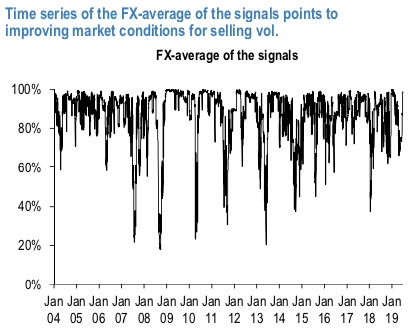
We introduced a tactical filter for timing FX short-Gamma trades (1M 25-delta strangles) in a recent piece (Timing FX short-vol strategies). EURUSD, USDCHF, USDMXN, and USDCNH are the sole four case where the latest trading signals by the model are below 100% (max short-vol capacity). As we can see from the above chart, the average signal for short-Gamma as recommended by the model has gradually increased from the late May lows, when trade wars and monetary policy uncertainties were weighing on vol premia, suggesting a more cautious stance. Courtesy: JPM







