


 Lithium Market Poised for Recovery Amid Supply Cuts and Rising Demand
  Gold Prices Slide as Rate Cut Prospects Diminish; Copper Gains on China Stimulus Hopes
  2025 Market Outlook: Key January Events to Watch
  RBI Uses $10 Billion Currency Swaps to Drain Excess Rupee Liquidity
  Urban studies: Doing research when every city is different
  European Stocks Rally on Chinese Growth and Mining Merger Speculation
  Australia Consumer Confidence Plunges as RBA Rate Hike Hits Households
  Oil Prices Dip Slightly Amid Focus on Russian Sanctions and U.S. Inflation Data
  Fed Unveils Stablecoin Rules Under GENIUS Act
  U.S. Treasury Yields Expected to Decline Amid Cooling Economic Pressures
  RBA Hikes Interest Rate to 4.60% as Inflation Risks Rise
  BOJ Raises Interest Rate to 31-Year High as Yen Weakens
  Geopolitical Shocks That Could Reshape Financial Markets in 2025
  U.S. Banks Report Strong Q4 Profits Amid Investment Banking Surge
  Bank of America Posts Strong Q4 2024 Results, Shares Rise


 Add as a preferred source on Google
Before we begin with this write-up, please go through our previous article on this pair:
We had advocated a hedging piece on any abrupt CNH appreciation, accordingly, you could observe since January 3rd CNH gained substantially.
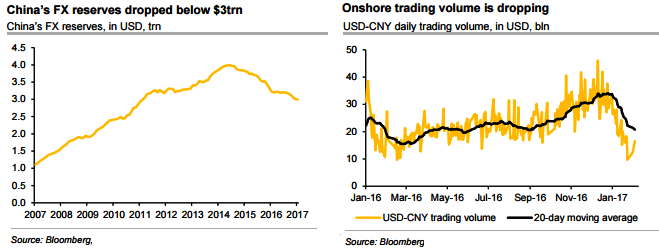
The China’s FX reserves dipped below the USD3trn watermark in the first month of 2017. Indeed, China has burnt down USD1trn FX reserves to conduct direct FX market intervention since mid-2014. However, this has not changed the market expectations over CNY exchange rates.
FX reserves dipped to below $3trn China’s FX reserves dropped below the psychological level of USD3trn at the end of January, at USD2.998trn, from USD3.01trn in the prior month. This is the first time since February 2011 that China’s FX reserves have fallen below USD3trn. Clearly, capital outflow pressures remain despite the presence of supportive factors.
First, EUR and JPY appreciated 2.7% and 3.7% against the USD respectively in January, which should increase China’s FX reserves to gain USD30bln from a valuation perspective (we assume that 2/3 of China’s FX reserves are in USD, 20% in EUR, 10% in JPY).
Second, China’s central bank actually reduced the outright intervention in both onshore and offshore markets over the past few months, which should have helped to slow down the decline of reserves. Instead, they conducted administrative measures to reduce USD purchase flows in the onshore market, while increasing the cost of shorting CNH in the offshore market to fight against market speculators;
Third, due to Chinese New Year holidays, there were fewer trading days in January, and the corporates are normally less active during holiday seasons. In fact, the trading volume on the onshore market also dropped dramatically in January.
(Refer above chart) Nonetheless, the fact that China holds less than USD3trn FX reserves right now means that China has to rethink its intervention strategy. Since mid-2014, China’s central bank has burnt down almost USD1trn FX reserves to conduct the market intervention. However, it does not make too much sense as the market expectations are unlikely to be changed.
Well, for now, we advocate upholding below hedging vehicles:
Buy USDCNH 1y topside seagull, strikes 6.80/7.20/7.50, zero cost (indicative, spot ref: 6.8330), the structure is a standard 1y call spread strikes 7.20/7.50 fully financed by selling a put strike 6.80, exposed to a maximum USDCNH appreciation of 4.2% at expiry.







