


 Goldman Predicts 50% Odds of 10% U.S. Tariff on Copper by Q1 Close
  Bitcoin Eyes $87,200 Breakout After Weak U.S. Jobs Data
  Jay Clayton Named Trump’s AI Czar as XRP Past Resurfaces
  JPMorgan CEO Jamie Dimon Warns Mythos AI Raises Cyber Risk Tenfold
  Fairshake Backs 32 Pro-Crypto House Candidates
  Fed’s Hammack Says Bond Yield Surge Is Not Driven by Inflation Fears
  Sector Spotlight: Data Availability and Storage Lead 24-Hour Market Gains
  Fed’s Williams Signals One More Rate Hike Before Year-End
  Zcash Mining Profits Surge as Liquidity Risks Grow
  UBS Projects Mixed Market Outlook for 2025 Amid Trump Policy Uncertainty
  U.S. Stocks vs. Bonds: Are Diverging Valuations Signaling a Shift?
  Global Markets React to Strong U.S. Jobs Data and Rising Yields
  Trump’s "Shock and Awe" Agenda: Executive Orders from Day One
  Energy Sector Outlook 2025: AI's Role and Market Dynamics
  Bitcoin Bull Cycle Still Early as XRP, NEAR Consolidate


 Add as a preferred source on Google
We reckon that it is premature to crown the dollar king and extrapolate continued broad USD strength into and through the second half of the year due to many time fundamental factors. Yes, the cyclical divergence is still favouring the USD and is narrowing.
While USDJPY had remained in a narrow range with some bearish interests (2% from mid-109 to mid-111) until early this week as both USD and JPY moved together. USDJPY this week extended its downside and heading for 110 level.
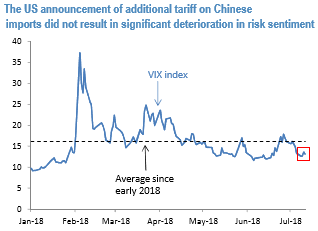
This week’s USDJPY rally despite the US-China trade war deterioration was somewhat puzzling to us, but it likely reflects market optimism about the situation. It is consistent with that the US announcement of additional tariffs on $200bn worth of Chinese imports did not trigger the VIX spike (refer above chart). Whether the markets can keep up with the optimism would be important for JPY in near future.
This week, the US Fed is expected to hold rates as widely anticipated. Upcoming data would likely reinforce the views for further hikes.
While the Bank of Japan is also scheduled for its monetary policy that is most likely to dispel policy normalisation expectations.
As USDJPY was well anticipated for price spikes in short run, the pair has significantly risen from the lows of 104.629 levels to the recent highs of 112.420 levels amid the major downtrend, we’ve already advocated diagonal put ratio back spread about a fortnight ago.
Diagonal Put Ratio Back Spread as Volatility Trading Strategy Amid Bearish Scenarios:
The execution: If you ponder upon cost effectiveness and wouldn’t like to divert exposure, we advocate buying USDJPY 2w/2m put ratio back spread strikes 112.634/110.595 (2 lots), (vanilla: 0.75%, spot ref: 111.09). A 2:1 put back spread can be implemented by buying a number of puts at a higher strike and buying twice the number of puts at a lower strike.
Rationale: The current implied volatility of ATM USDJPY contract is trading at 15.35%, as the positively skewed IVs of 2m tenors signify the hedging sentiments for the further downside risks over the period of time, this appears to be conducive for put option holders. On the flip side, it is wise to utilize abrupt rallies amid shrinking vols in the below-stated options strategy.
The positively skewed implied volatilities of 2m tenors signify the hedging sentiments for the further downside risks, this appears to be conducive for put option holders.
This bearish sentiment is substantiated by the mounting negative risk reversal (RRs) numbers, and negative RRs indicate the hedging sentiments for the bearish risks appears to be intact.
What makes strategy more attractive: Short leg (ITM shorts) of this strategy would have fetched attractive yields as the underlying spot FX has significantly spiked above, while long legs are yet to function having two months of expiry.
The short leg with narrowed expiry likely to benefit time decay advantage which in turn reduces hedging cost on the long leg of ATM put. Courtesy: JPM
Currency Strength Index: FxWirePro's hourly JPY spot index has shown -78 (which is bearish), while the hourly USD spot index was at 66 (bullish) while articulating at 09:07 GMT. For more details on the index, please refer below weblink:







