


 Gold vs Bitcoin: Investors Eye Inflation Hedge as Crypto Adoption Grows
  Morgan Stanley Predicts $10 Trillion RWA Market by 2030
  XRP Price Drops 3% Despite Ripple-Backed Evernorth Nasdaq Debut
  Cardano Price Drops 15% as Whales Sell 110 Million ADA
  Fed May Resume Rate Hikes: BofA Analysts Outline Key Scenarios
  US Gas Market Poised for Supercycle: Bernstein Analysts
  UBS Projects Mixed Market Outlook for 2025 Amid Trump Policy Uncertainty
  U.S. Stocks vs. Bonds: Are Diverging Valuations Signaling a Shift?
  Crypto Derivatives Dashboard: Bulls Retain Control Amid $488M Liquidation Flush
  Pi Network Price Eyes $0.10 Ahead of Protocol 28 Upgrade
  Energy Sector Outlook 2025: AI's Role and Market Dynamics
  Trump’s "Shock and Awe" Agenda: Executive Orders from Day One
  Ripple-Backed Evernorth Set for Nasdaq Debut With 473 Million XRP
  Gold's Tug-of-War: Geopolitical De-escalation Fights Falling Yields as Markets Eye US CPI
  Most Americans Oppose Election Betting on Prediction Markets, Poll Finds
  European Stocks Rally on Chinese Growth and Mining Merger Speculation
  Wall Street Analysts Weigh in on Latest NFP Data


 Add as a preferred source on Google
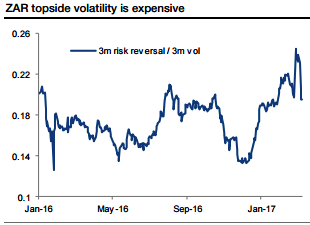
The implied volatility of the South African rand is the highest among EMFX space, though not unjustifiably expensive versus realized volatility, which makes any vanilla USDZAR put option expensive.
Skew is also elevated, with 3m 25d risk reversals being the highest across EM and in the upper half of the five-year historical range. The skew-to-ATM implied volatility ratio is at the top of the recent range, affording an opportunity to sell topside skew in a bullish ZAR structure.
Option mechanism:
Buy 3m USDZAR put strike 13.00 knock-out (KO) 14.20, indicative offer: 1.45% (vs 2.13% for the vanilla, spot ref: 13.0750).
The knock-out provides a 32% discount to the vanilla put option and also substitutes for a stop loss on outright short USDZAR exposure.
Risks profiling:
4% spike in next three months Investors buying a knock-out put cannot lose more than the premium paid.
However, the option will be worthless if USDZAR hits the 14.30 level at any time before the 3m expiry.
A strong payroll report could temporarily hurt the ZAR, and while a Fitch downgrade is partially priced in, it could cause another bout of temporary weakness.







