


 NEAR Price Surges 11% as Trading Volume Doubles
  Global Markets React to Strong U.S. Jobs Data and Rising Yields
  European Stocks Rally on Chinese Growth and Mining Merger Speculation
  DeFi Development Adds 22,070 SOL to Solana Treasury
  Bank of America Posts Strong Q4 2024 Results, Shares Rise
  Bitcoin Price Drops as US Dollar Hits 18-Month High
  Wall Street Analysts Weigh in on Latest NFP Data
  Monero Price Holds $515 Support as XMR Eyes $545 Breakout
  Gold's Tug-of-War: Geopolitical De-escalation Fights Falling Yields as Markets Eye US CPI
  Geopolitical Shocks That Could Reshape Financial Markets in 2025
  Cardano Hits Five-Year Transaction Record as ADA Price Falls
  Indonesia Surprises Markets with Interest Rate Cut Amid Currency Pressure
  Moody's Upgrades Argentina's Credit Rating Amid Economic Reforms
  Gold vs Bitcoin: Investors Eye Inflation Hedge as Crypto Adoption Grows


 Add as a preferred source on Google
The euro area corporates are in a good position to expand, the corporates in this geography have become net savers and low-interest costs, lower dividend payouts, lower CapEx explains the shift.
Corporates’ capacity to accelerate CapEx looks good.
A couple of months ago, we still expected the Euro area to grow at only a modestly above-trend pace this year. However, business and consumer sentiment have improved sharply, with the composite PMI signaling 3% growth in March. This prompted us to raise our 2017 growth forecast to 2.2% Q4.
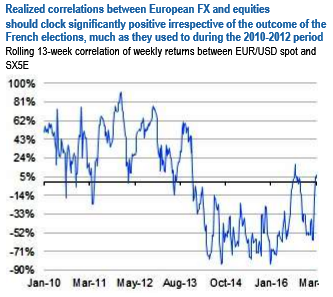
European FX vs. equity implied correlations currently trade in the 0 -20% range in 6M –1Y expiries, which might be fair relative to current realized correlations but ought to reprice higher in coming months if a concerted European asset rally reverts corrs back to average levels of the 2010-2012 period (refer above chart).
Investors have already started to take advantage of this dislocation and forced short-dated (<3M) EURUSD vs. SX5E correlations up to +25%, but there is still room for the move to play out in longer tenors.
EURUSD > 2% OTMS, SX5E > 5% OTMS: dual digitals costs 14.5% EUR indic. in 3M tenors (indiv. digis 43% and 26% respectively) and 18.5% EUR indic. in 1Y (indiv. digis 58% and 37% respectively).







