
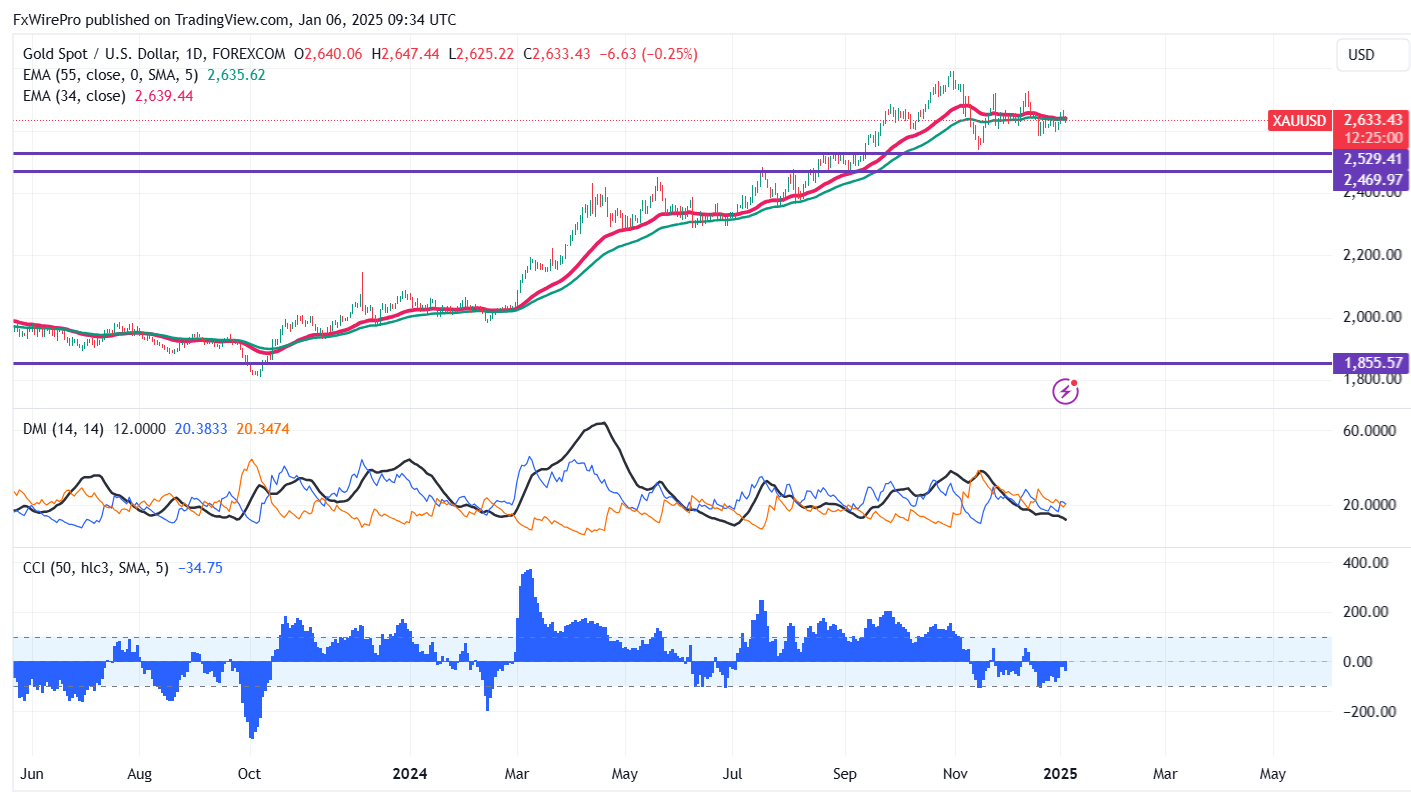
Gold showed a minor sell-off due to a strong US dollar, hitting an intraday high of $2,666 and currently trading around $2,634.
Economic Indicators from the Manufacturing Sector
On January 3, 2025, the ISM Manufacturing PMI for December showed a slight improvement, rising to 49.3% from 48.4% in November, marking the highest level since March 2024. The New Orders Index increased to 52.5%, indicating growth in new orders for the second consecutive month. However, while production grew, employment continued to shrink, highlighting ongoing challenges in the manufacturing sector, including increasing prices and weak demand.
Market Sentiment and Upcoming Data
Market participants are closely watching the upcoming FOMC meeting minutes and US Non-Farm Payroll data for further market direction. The CME FedWatch Tool indicated an increased likelihood of a Fed rate pause, rising to 90.90% from 88.20% a week prior.
Technical Analysis of Gold Prices
Currently, gold prices are above both short-term and long-term moving averages, suggesting a bullish trend. Immediate support is found at $2,630; a break below could drop prices to $2,620, $2,600, $2,570, $2,559, $2,536, and eventually $2,500. Near-term resistance is at $2,670, with potential price targets at $2,700 and $2,775. It’s advisable to buy on dips around $2,630, with a stop-loss at $2,600 and a target price of $2,725.


