Nurturing a forest ecosystem back to life after it’s been logged is not always easy.
It can take a lot of hard work and careful monitoring to ensure biodiversity thrives again. But monitoring biodiversity can be costly, intrusive and resource-intensive. That’s where ecological acoustic survey methods, or “ecoacoustics”, come into play.
Indeed, the planet sings. Think of birds calling, bats echolocating, tree leaves fluttering in the breeze, frogs croaking and bush crickets stridulating. We live in a euphonious theatre of life.
Even the creatures in the soil beneath our feet emit unique vibrations as they navigate through the earth to commute, hunt, feed and mate.
Eavesdropping on this subterranean cacophony using special microphones can provide researchers with important insights into ecosystem health. Our new study published in Restoration Ecology shows ecoacoustics can provide an effective way of monitoring biodiversity in soil and in the forest it supports.
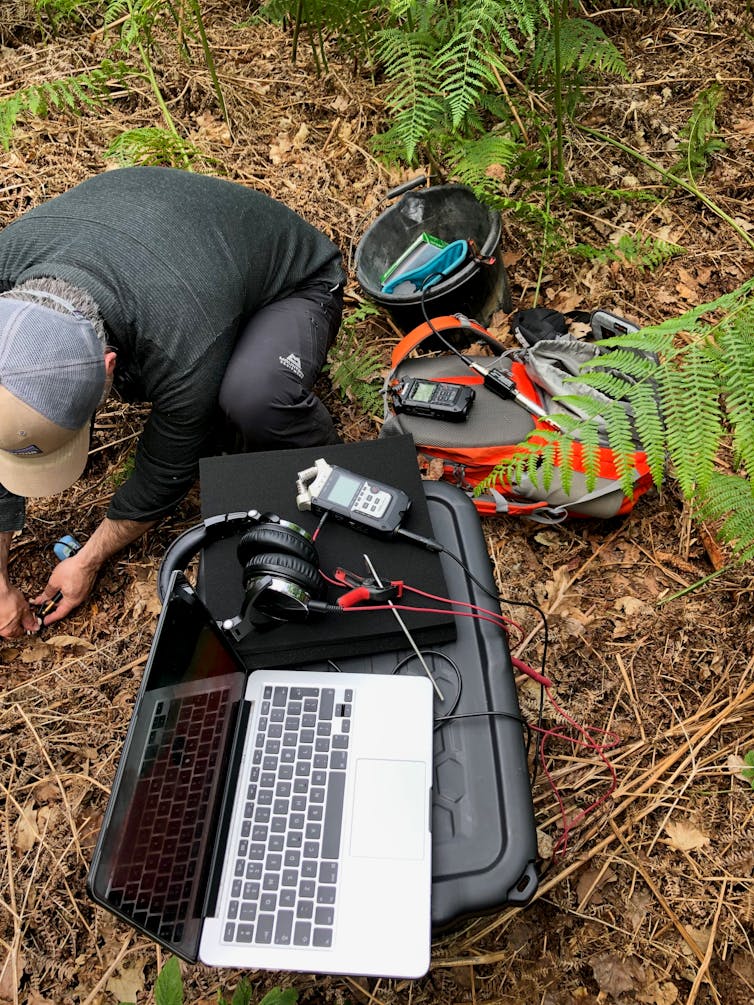
Setting up the ecoacoustics field trial. Jake M. Robinson, Author provided
What did the study do?
Acoustic technology is widely used to survey bats, birds and other creatures. However, scientists who restore degraded ecosystems have yet to make full use of soil ecoacoustics. This is despite its demonstrable effectiveness at detecting small animal vibrations.
Our study applied ecoacoustic tools to measure biodiversity above and below ground in a UK forest. We hypothesised that the soils of forests restored to a healthier state would have a higher diversity of sounds than the soils of recently deforested plots. This is because we assumed more creatures would live in the restored and “healthier” soils, producing a greater variety of sounds that we would detect.
Think of two symphony orchestras. Half of one orchestra’s musicians have fallen ill and can’t play at the concert. This is analogous to a degraded ecosystem. In contrast, the other orchestra has all its members and will therefore be louder, with more complex and diverse sounds.
During the spring and summer of 2022, we collected 378 samples from three recently deforested and three restored forest plots. We created a recording system with special “contact” microphones that we inserted into the ground.
We used a chamber with sound-dampening foam inside to record soil creatures such as earthworms and beetles. This chamber allowed us to block out unwanted signals such as mechanical noise, wind and human activity. The chamber housed the microphone and a 5 litre sample of the soil at each plot.
Our results were exciting. The diversity of sounds was much higher in the soil from the restored plots. This finding confirmed our suspicions that healthier soil would be more tuneful.
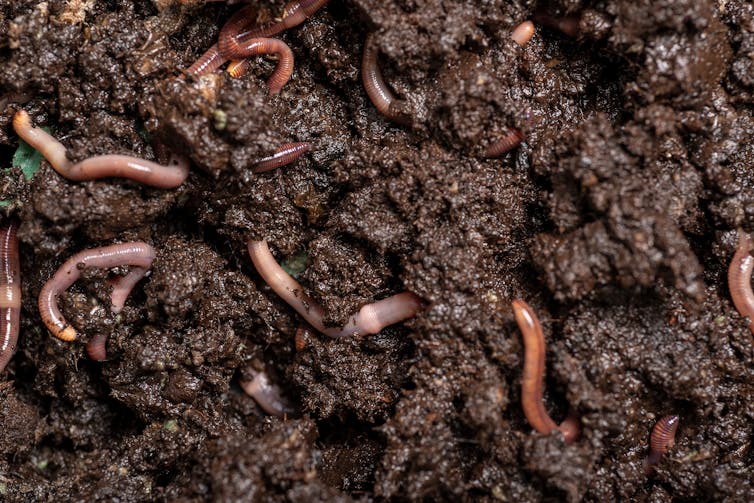
Earthworms make sounds as they digest organic matter and tunnel through the soil. Shutterstock
Why is monitoring soil health important?
Our preliminary findings suggest ecoacoustics can monitor life underground. But why is monitoring soil biodiversity so important? Soil health is the foundation of our food systems and supports all other life on land. It should be a global priority.

Birds, including Australian magpies, are known to listen for worms. Scientists can also use the sounds of the soil to assess its health. Shutterstock
The “unseen” and “unheard” organisms living in the soil maintain its health. Below-ground organisms, such as earthworms and beetles, play a crucial role in nutrient cycling and soil health. Without them, forests can’t thrive.
By using ecoacoustics to monitor below-ground biodiversity, ecologists can better assess the effectiveness of restoration efforts. This will allow them to make more informed decisions about the best ways to protect nature.
Using ecoacoustics in restoration efforts could also have important implications for climate change mitigation. Forests are crucial carbon sinks. They absorb CO₂ from the atmosphere and store it in their woody biomass and soils.
In contrast, degraded or deforested areas are significant sources of carbon emissions. Restoring these areas and monitoring subterranean life can help reduce carbon emissions and improve our ability to reduce the effects of a changing climate.
It’s still an emerging science
The use of ecoacoustics in restoration efforts is still relatively new, but it’s an important step towards a more holistic and effective approach to ecosystem recovery. By embracing new technologies and approaches, we can work towards a healthier and more sustainable planet.
Of course, there are challenges we still have to overcome. For instance, accurately identifying the sources of acoustic signals in a complex soundscape can be challenging. However, as technologies and methods continue to improve, the potential benefits of ecoacoustics are immense.

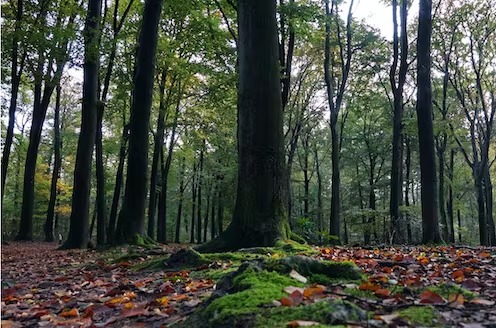
When a forest like this temperate woodland in the UK is healthy, it acts as a carbon sink. Pixabay
By monitoring life underground in a non-intrusive and efficient way, we can better understand the effectiveness of our restoration efforts. This will help us make more informed decisions about how to protect nature.
We’ve only just begun to scratch the surface when it comes to the possibilities of ecoacoustics in restoration efforts. It’s an exciting time for those working in this field, as we discover new ways to use sound to heal our planet.