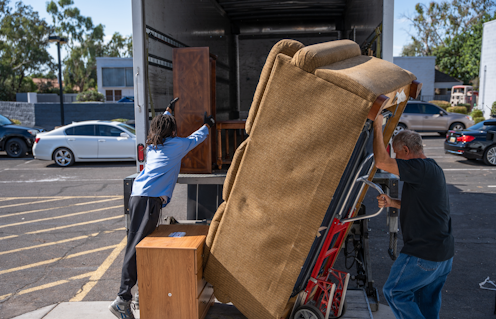
Telling donors that their neighbors have provided high-quality furniture, clothing and other goods can cut the number of worthless items charities receive in half.
That’s what my colleagues Sindy De La Torre Pacheco, Mahyar Eftekhar and I found when we partnered with the Phoenix chapter of the Society of St. Vincent de Paul, a charity that helps low-income people, for an experiment.
Over 12 days in the fall of 2020, we followed 763 people who registered to give the charity their used couches and other stuff. These donors were randomly assigned to receive one of two emails tied to our study or no email at all before the charity picked up the stuff being given away.
One email stated, “The majority of donors give us items that are in very good condition, and have a high likelihood of being sold at our thrift stores around the Valley.” The other asserted, “Please know that we only accept items that are gently used. Items that we would have high difficulty selling at our stores end up costing us tens of thousands of dollars every month to dispose of them, which diverts money away from our mission.”
According to drivers picking up the donated goods, the items’ average quality was 15% higher when donors received the first email than when they got the other one – or none at all. That 15% improvement, in turn, resulted in a 50% reduction in donations that had to be thrown out.
Telling people how much it costs to sort through a mix of valuable and worthless stuff and disposing of the latter didn’t improve the overall quality of donations. That’s important, because it’s what most nonprofits do to discourage donations they’ll need to throw away.
We believe peer pressure worked best because people don’t like being lectured about what it costs charities to receive stuff they can’t give away or sell at an affordable price to people in need. At the same time, people do tend to conform to social norms when they learn about them.
Importantly, we found evidence that emphasizing what other donors were doing right did not discourage donors from giving items to the charity again.
We figured that out by tracking the same 763 donors for another year to see whether they would make additional in-kind donations. All were equally likely to do so, and about 1 in 5 gave more items to the charity.
Why it matters
In 2020, when we conducted this experiment, about half of U.S. households donated clothing, food or other items to a nonprofit. These donations can help charities cut their costs and increase their impact while reducing the volume of a community’s solid waste. That same year, Goodwill diverted 3.3 billion pounds of usable goods from landfills, and the Salvation Army reported US$598 million in revenue from its 1,116 thrift stores, accounting for 18% of its total revenue that year.
Unfortunately, not all donated goods are useful. Sorting through all that stuff takes a lot of time and can cost a lot of money, as does disposing of items destined for the dump.
For example, Goodwill Northern New England spends over $1 million annually to dispose of 13 million pounds of unsuitable items from just 30 thrift stores. Despite this financial burden, rejecting donations outright can harm relationships with donors. That means Goodwill, the Salvation Army and similar groups need to figure out how to reduce the flow of worthless donations without alienating their supporters.
What still isn’t known
Discovering why many donors prefer to give low-quality used goods away is crucial for developing strategies that would improve charitable practices.
More research is needed to see whether the successful approach we identified would work across the board, or whether it’s worth trying only in certain situations and with particular communities.
What’s next
Our study focused on improving the quality of donated items. But many social service groups would be better off if more donors gave money instead.
My research team is now working on a study to see which strategies are the most effective for getting donors to provide cash instead of goods.
The Research Brief is a short take about interesting academic work.