


 Bitcoin Bull Cycle Still Early as XRP, NEAR Consolidate
  Australia Consumer Confidence Plunges as RBA Rate Hike Hits Households
  DogecoinVM Makes DOGE Transactions 300x Faster
  RBI Raises Repo Rate to 5.50% in Hawkish Shift on Inflation Risks
  US Treasury Yields Ease After Strong 10-Year Auction as Global Bonds Struggle
  Circle Stock Falls 4% as Crypto Selloff Overshadows SAP Pay Expansion
  Yen Sinks as BOJ Rate Hike Fails to Impress Markets
  Asian Currencies Mixed as Yen Weakens, Dollar Holds Firm
  ECB May Stop Rate Hikes After December, Capital Economics Says
  Fed’s Logan Signals 50 Basis Points More in Rate Hikes
  Dollar Retreats From 18-Month High as Euro Rebounds
  Zcash Privacy Demand Rises as AI Exposes Bitcoin Transactions
  Solana User Growth Jumps 33%, Outpacing Ethereum and Chainlink


 Add as a preferred source on Google
Hungary’s central bank left its benchmark interest rate at a record low of 0.9 percent for a fifth month in October and signaled that the easing cycle is finished for now. The central bank, which targets 3 percent price growth in the medium term, said at its October meeting that it still saw the inflation environment as “subdued.”
Hungary's inflation rose more-than-expected to hit a 3-year high in October, data released by the Hungarian Central Statistical Office showed on Tuesday. Inflation rose to 1 percent in October from 0.6 percent in September, beating forecasts for a rise of 0.8 percent. This was the highest since September 2013, when prices advanced 1.4 percent. MNB in October lowered its inflation projections for 2016, but forecasts core inflation to accelerate to 2.9 percent in 2017.
"In our view, however, CEE core inflation does not show any real sign of turning around. All signs of acceleration are limited to the influence of energy price base effect on year-on-year rates of change. Mild acceleration in such year-on-year rates is unlikely to lead to sustainable inflation acceleration back to target," notes Commerzbank in a report.
Moody's upgraded Hungary's debt into investment grade late on Friday. Fitch did this first in May, S&P surprisingly upgraded in September. The forint has firmed in the past months due to Hungary's improving economic fundamentals and ratings upgrades. Money managers will likely be increasing their portfolio exposure to Hungarian assets, which would be further HUF-supportive in the near-term.
Hungarian central bank (NHB) Governor Gyorgy Matolcsy told in an interview today that the central bank could keep its main base rate at 0.9 percent in the long term even if major central banks start hiking interest rates. Matolcsy said the bank, which has provided cheap funding was not planning a similar loan programme in the second half of his six-year term. Separately, the bank said on its website that underlying indicators still pointed to low inflation pressures.
"We have set ourselves for a base rate level which can work in the long term, which can be maintained even if the Fed carries out a new rate hike cycle in several steps and if potentially the ECB and the Japanese central bank respond to that," Matolcsy said.
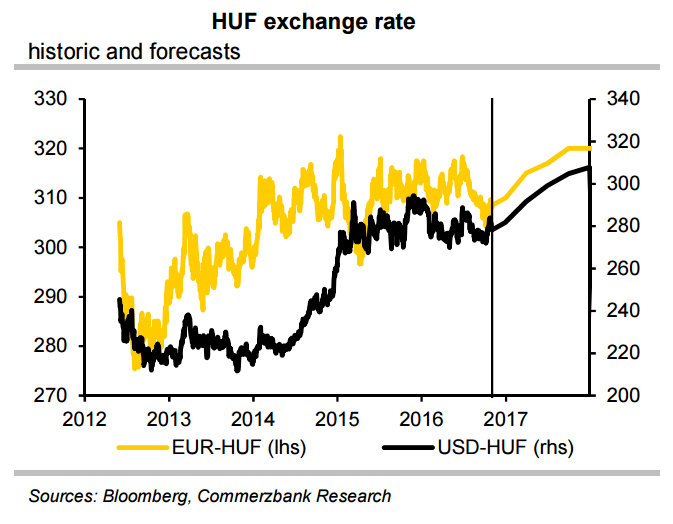
EUR/HUF edged lower from day's highs around 306.25 to trade at 305.70 at around 12:15 GMT. Intraday bias for the pair remained lower. 5-DMA at 306.46 was immediate resistance on the upside, while downside finds little support till 303.32 (Oct 7 lows).







