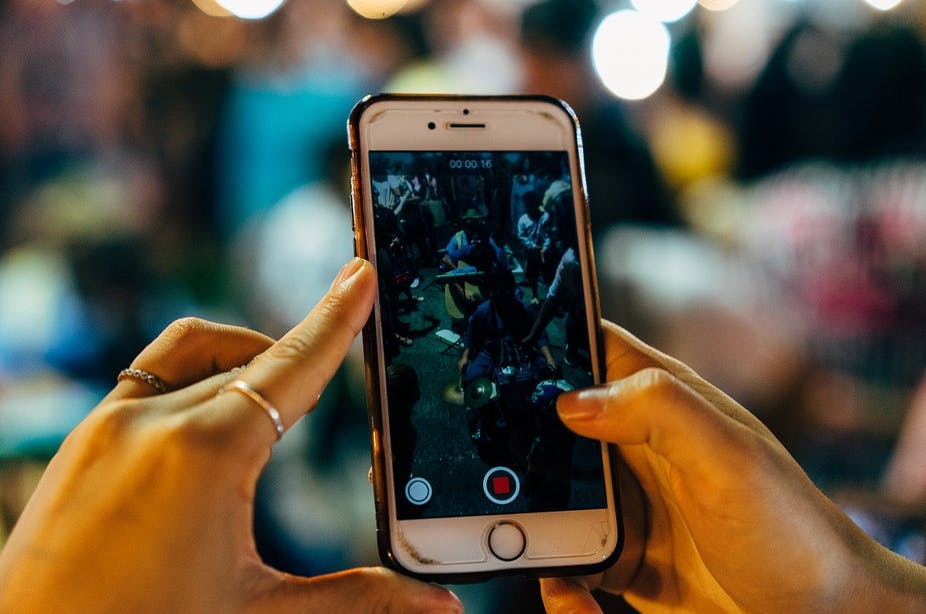
At least 65% of Indonesians, or 175 million people, are connected to the internet. Nearly all of them (98%) access the internet via their mobile device and they spend around four hours a day online.
Indonesia has the the fourth-largest number of internet users in the world after China, India and the United States. The high mobile use in Indonesia has also changed the way people consume news. Unlike the generations before them, younger Indonesians no longer read newspapers and magazines, or listen to news radio. They turn to their mobile phones to get the latest news.
As the majority of Indonesians have turned to their smartphones to get news updates, local media are forced to adopt the practice of mobile journalism.
Journalism expert Oscar Westlund from Oslo Metropolitan University, Norway, defines mobile journalism as the production and distribution of news via a mobile device.
However, despite the increasing need for mobile-based news content in Indonesia, I argue that the adoption of mobile journalism practice by local media is still immature. This is due to limited human resources and poor access to the technology.
Mobile journalism in Indonesia
An associate professor of journalism at Ithaca College’s Roy H. Park School of Communication in the US, Anthony Adornato describes a “mobile-first culture” that is taking shape in many newsrooms, and Indonesia is no exception.
Many Indonesian media have shifted to mobile journalism. This includes the country’s biggest media group, Kompas.
Kompas established its online division kompas.com 25 years ago. In 2018, it created a dedicated team to develop mobile journalism.
“This is not without reason as 80% of our readers access kompas.com via mobile devices,” says Laksono Hari Wiwoho, kompas.com’s news assistant managing editor.
Kompas is not alone. A number of media have followed suit, including new media like Narasi TV, a digital television media start-up established in 2018.
Narasi TV has 14 programs distributed digitally through both its website and YouTube. Its founder, Najwa Shihab, says Narasi TV aims to produce better-quality mobile-first stories and ensure the content is mobile-friendly for viewers.
Challenges
Mobile journalism in Indonesia is still in its infancy.
Internet connectivity remains a big challenge for reporters.
“The quality of a limited internet network often slows down or stops the process of sending videos. This condition is even worse if we want to go live or to stream,” says Laksono.
Another obstacle is that interviewees, especially government officials, do not fully understand how mobile journalists work. They don’t consider news produced by small devices like mobile phones professional enough to be delivered to the public.
“Many government officials underestimate mobile journalists who want to interview with a smartphone. Mobile journalists are often accused as fake reporters, even when they equip themselves with press cards,” said Andi Muhyiddin, head of digital experience at Liputan6.com.
Liputan6.com reporters have written, taken pictures and recorded videos to produce news stories since 2019.
The quality of human resources is also a problem.
Journalists are expected to produce and share content across different platforms and at the same time to interact with audiences. But not many have these skills.
Therefore, all stakeholders in the media ecosystem in Indonesia have a lot of homework to do to realise the full potential of mobile journalism.
With the number of journalists in Indonesia exceeding 120,000 people, one of the highest totals in the Asia-Pacific region, I believe every modern journalist needs to have basic training in how to produce news with their mobile devices.
Local media associations like the Alliance of Independent Journalists and the Indonesian Journalists Association can work together to offer this kind of training to reporters. They can collaborate with universities to develop curriculum and training modules.
Mobile journalism opens new opportunities for media in Indonesia. Improving internet access, quality and affordability will be a starting point to support the development of mobile journalism.
Mobile journalism poses new challenges for media in Indonesia but what matters is the ability to adapt to the new normal.