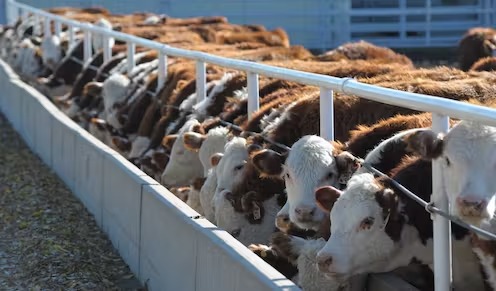
Lobbyists from major polluting industries were out in force at the recent UN climate summit, COP28. Groups representing the livestock industry, which is responsible for around 32% of global methane emissions, want to increase their use of a new way of measuring these emissions that lets high polluters evade their responsibility to make big emissions cuts.
Not all greenhouse gases are created equal. Carbon dioxide, the biggest driver of global warming, will build up in the atmosphere when continuously emitted, warming the Earth for centuries to come. Methane, the second-biggest driver, is more effective at trapping heat in the atmosphere, but most of it naturally breaks down a couple of decades after being emitted. The damage from a single burst of methane is intense but limited.
When emitted continuously, the additional heating caused by methane will remain constant after the initial rise. But ramping down methane emissions rapidly would have a swift and positive effect on global heating.
To understand the climate effects of different activities and develop pathways consistent with limiting warming to 1.5°C, it is often useful to combine the effects of different gases into a single metric. GWP100 – a gas’s global warming potential over 100 years – has become the dominant metric and has been adopted as a standard by the UN.
However, GWP100 fails to capture the different ways methane and carbon dioxide behave in the atmosphere. It also masks the more intense short-term effect of methane compared to carbon dioxide. GWP100 simply measures the mass of each gas released into the atmosphere and considers 1kg of methane as equivalent to 28kg of carbon dioxide in terms of its climate impact.
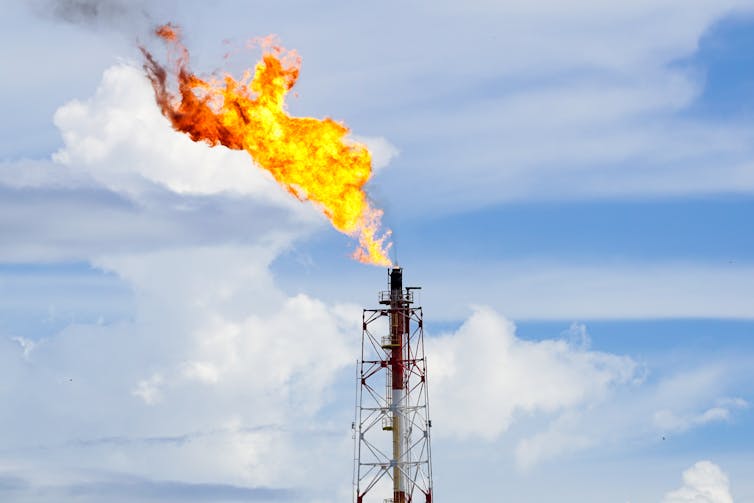
Carbon dioxide and methane behave differently in the atmosphere. hkhtt hj/Shutterstock
So in 2016, scientists at the University of Oxford proposed a new method for modelling methane and carbon dioxide together called GWP*. This model is more complex and takes account of both the level of emissions and the changes in emissions compared to a recent baseline year.
But, because it relies on changes since the baseline year, GWP* can allow a historically high emitter to look good by making minor cuts to their emissions.
When used at any level other than globally, the use of the baseline year bakes in the current unequal distribution of responsibility for methane emissions and simply projects this situation into the future. The usual baseline year is 20 years before today, and so would imply rich countries’ retaining their high share of global methane emissions, mainly due to their high meat and dairy consumption.
This precludes any debate about the equity of responsibility for current and ongoing emissions, and favours today’s high emitters, while not allowing developing countries with low emissions any space to grow in the future.
Twisted tools
The tempting narrative that some in the beef and dairy industry have started to promote is that GWP* (“the latest science”) tells us methane emissions are not as serious as we thought they were, and only small reductions are required.
Industry-backed statements along the lines of the “UK’s livestock is not contributing to climate heating since numbers have not increased in recent years” may seem correct and convincing when looking at the GWP* results without delving into the nuances. The correct statement, however, is that the “UK’s livestock is not contributing additional warming compared to already high levels”. This is what incorrect use of GWP* masks.
This narrative is dangerous. It can be used to shift the burden of responsibility for tackling climate change further away from the agricultural sector. And it conceals the important role that methane reduction can play in keeping temperature rise to within 1.5°C, particularly by enabling near-term reductions of warming.
We need all emissions to reduce quickly and immediately. There are no trade-offs to be made.
The authors of GWP* cautioned that using it to water down ambitious climate mitigation targets would lead to invalid results. If GWP* was used properly (as a global climate model), it would show that GWP100 has been partially masking the benefits of rapid and permanent reduction in methane emissions, not least due to a reduction in ruminant livestock numbers. This is again due to GWP100 averaging methane’s effects over a century.
Because of the added complexity of GWP*, and future projections of the distribution of emissions of key greenhouse gases, it is not a drop-in replacement for existing greenhouse gas accounting metrics like GWP100. To do so is akin to setting a temperature target in celsius but then reporting progress in fahrenheit.
Research has found that such a replacement would imperil the Paris agreement’s goals. The meat and dairy lobby are (correctly) betting on policymakers not understanding these subtle yet vital differences. We must not allow these high emitters to shirk their responsibilities.