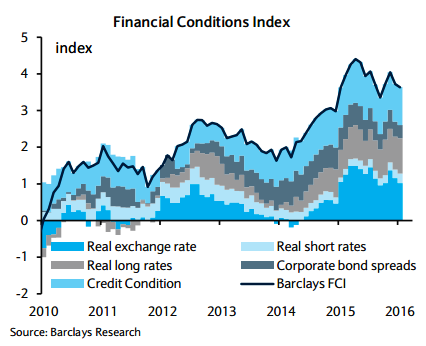
After lowering its repo rate by 10bp and extending its quantitative easing in December 2015, the ECB left its key interest rates unchanged in Jan, even as low energy prices and concerns about China's impact on the global economy threaten to derail the central bank's efforts to bring inflation back to its target. However, President Draghi's comments at the January meeting reinforced market expectations of the ECB employing a depo rate cut again during the year.
"The price of the Eonia forward for the December 2016 reserve period at -47bp is consistent with about 90% probability of a cumulative 25bp cut in the depo rate by the end of the year (assuming Eonia stabilizing at depo +6bp)", notes Barclays in a research report.
More depo rate cuts are still an option for the ECB, but we think bold action from the central bank is highly unlikely. Deeply negative rates in a context of rising liquidity surplus (due to QE purchases) have the potential to severely hurt banks' profitability. Not only do banks have to deal with very low yields and compressed margins, which affect their earnings on bond portfolios and lending activity, but in some eurozone countries, legislation prohibits banks from passing on the cost of ECB deposits to final clients as they cannot charge negative rates on retail deposits.
At the January meeting President Draghi pointed out that protecting banks' profitability is not the ECB's mandate, but the central bank will definitely monitor the stability of the financial system as well as any unintended implications of more negative rates in terms of pass-through in the form of higher lending rates. Hence the ECB has limited room for manoeuvre and is likely to adopt a gradual approach, assessing the implications of each cut before deploying another one. As a consequence, It is unlikely that bold action of a 15bp or 20bp cut could be delivered in one meeting.
The BoJ's recent decision to move into negative territory now could represent an interesting "reference case" for the ECB and reinforce such expectations further. The ECB has never discussed such mechanism, but there is a possibility it could think about a similar deposit framework in the future to attenuate the impact on banks in case of aggressive reductions in the depo rate. However, such solution would not address the issue of the sustainability of a long period of deeply negative rates for the financial system as a whole. This represents the main hurdle for aggressive usage of the depo rate cut as an instrument for monetary easing. EUR/USD was trading at 1.1153 at 1110 GMT.