Myint Swe, the acting president of Mynamar’s military government, has warned that the country “will be split into various parts” after his armed forces suffered huge territorial losses to resistance fighters recently. His response was to call on Mynamar’s people to support his military forces, a call that is likely, based on previous experience, to fall mainly on deaf ears.
Far from sharing the military government’s fears of shrinking territorial control, it’s likely that most among Myanmar’s 55 million people will celebrate the army’s territorial losses. Junta misreads like this are not new – after they seized power in February 2021, the coup leaders indicated surprise when the coup met with widespread outrage and sustained public protest and resistance.
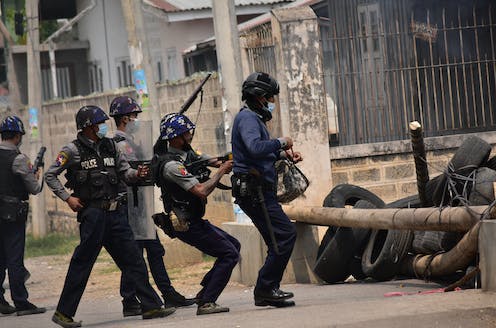
To quell opposition, military bosses have adopted a strategy of arbitrary arrest and extreme violence. The Assistance Association for Political Prisoners estimates 19,675 people are currently jailed – a figure which increases almost daily. Peaceful protests are met with army snipers and shoot-to-kill orders.
Myanmar’s military routinely responds to armed resistance by collectively punishing nearby civilian populations. This has included devastating airstrikes on civilian targets and scorched-earth “clearance operation” campaigns that have killed thousands of people and displaced more than 700,000 more. Rather than cowing the populace, junta violence continues to spur nationwide resistance.
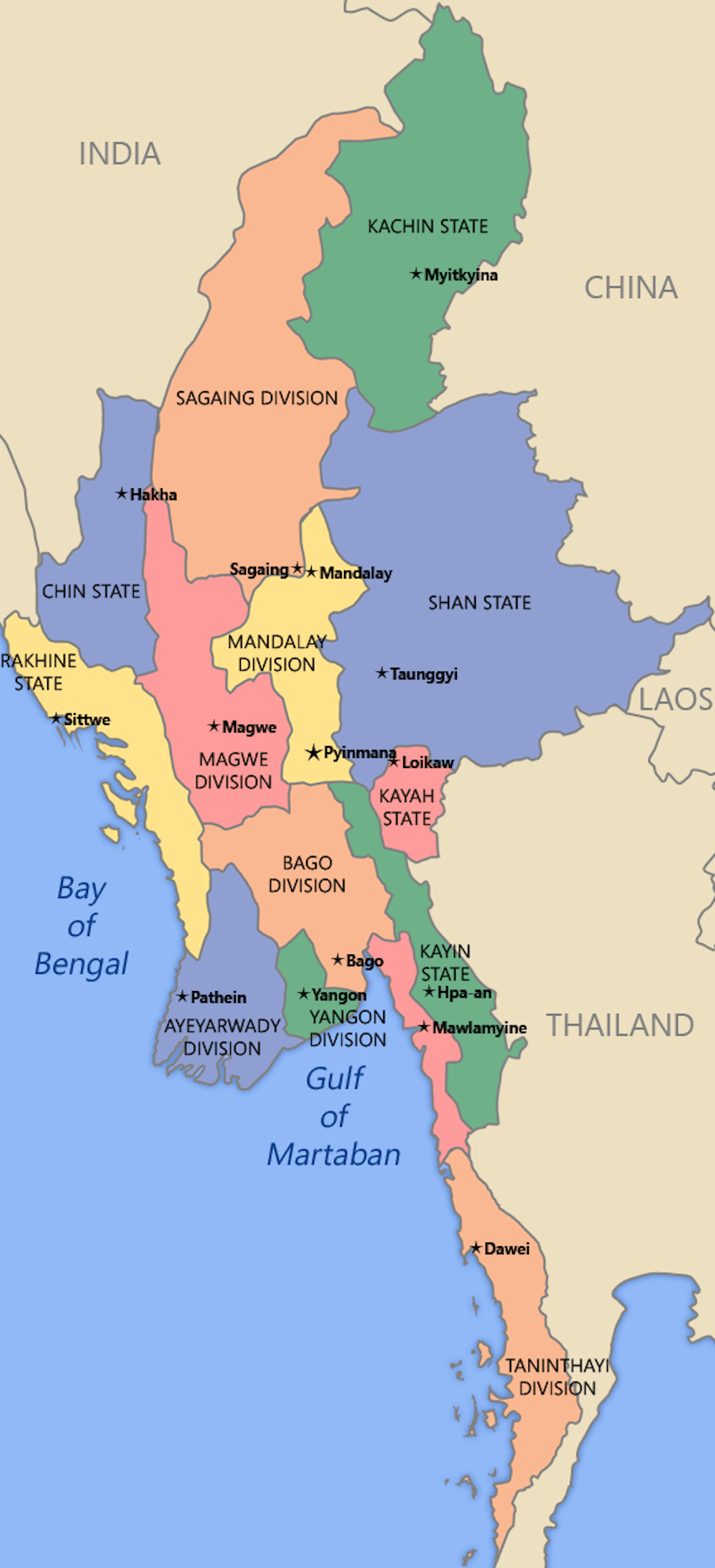
Myanmar is a patchwork of different states and ethnic groups. Hintha/Wikimedia Commons, CC BY-SA
Since September 2021, the National Unity Government (NUG), a shadow government in exile, has authorised a “defensive war” against the state military, pushing for the creation of militias targeting the junta and its economic base. NUG militias have increasingly coordinated with Myanmar’s dozens of ethnic armed groups, many of which have already been fighting the Tatmadaw (the junta’s military) for decades.
Now, every time government troops leave their barracks they face potential attack, causing them to increasingly lean on air power, but further limiting their ability to maintain effective control on the ground. Economic and territorial losses have steadily accumulated.
This is important because the Tatmadaw’s legitimacy depends on its ability to hold the country together. The controversial 2008 military-drafted constitution refers to “non-disintegration” of Myanmar a dozen times, including as a duty of the defence forces. This was a key justification for the 1962 military coup that ushered in five decades of military rule.
During the immediate post-independence period (1948-1962), Myanmar’s civilian government struggled to maintain territorial control, at times controlling little more than major urban centres. The situation is similar now, except that today it is the Tatmadaw that is unable to maintain control beyond urban centres and military barracks. This will hit junta morale badly and inspire further resistance.
The junta’s recent reversal in Shan State, its most significant territorial loss, came at the hands of three ethnic-based armed groups, the Arakan Army, Myanmar National Democratic Alliance Army, and the Ta'ang National Liberation Army. These three groups now coordinate their activities as the Brotherhood Alliance.
They inflicted heavy losses on junta forces in early November, overrunning dozens of military posts and killing the commander of the 99th Light Infantry Division, a unit known internationally for its genocidal campaign against the Rohingya community. The Brotherhood Alliance also captured the main overland route from Mandalay to China, a key economic corridor.
China’s role
Brotherhood Alliance members are themselves territorially ambitious, but rely on China for arms so it is unlikely an operation in China’s hinterland could have occurred without China’s acquiescence. Allowing this operation to go ahead is a strong statement by a Chinese government frustrated with the junta’s inaction on online scam centres in Shan State where thousands of trafficked Chinese and other foreigners have been forced to work in slave-like conditions.
China’s strategic ambiguity is unsurprising. China was far from enthusiastic about the 2021 coup. China’s ambassador to Myanmar, Chen Hai, told journalists at the time a coup was, “absolutely not what China wants to see”. While traditionally a key international ally of the junta, China’s leadership had a very close relationship with Myanmar’s ousted de facto leader, Aung San Suu Kyi, and maintains close ties with many of Myanmar’s ethnic armed groups.
Now, strategic reversals, nationwide territorial losses and economic decline mean momentum has strongly shifted away from Myanmar’s junta. China’s leadership may have read the situation better than most, recognising the junta may now be in a death spiral.
Others have been less shrewd. Russia has displaced China as the junta’s biggest arms supplier accounting for US$406 million (£326.5 million) of Myanmar’s arms imports since the coup and crucially providing aviation fuel in exchange for funds, access to Bay of Bengal port facilities, and regional relevance.
Coup leader Min Aung Hlaing recently welcomed Russia’s navy for joint manoeuvres, describing Vladimir Putin in glowing terms as a “leader of the world who is creating stability on the international arena”. For Putin, this may soon be embarrassingly unwelcome praise. By linking itself so closely with a declining junta, Russia guarantees its Myanmar influence and regional relevance will not outlast military rule.
Post-junta planning
The NUG idealises a post-junta Myanmar unified under its leadership with Aung San Suu Kyi returned to power. But for many ethnic armed groups – who will feel they, rather than the NUG, inflicted the strongest blows on the junta and now control significant territory – that is not likely their preferred outcome. They will seek guarantees about key demands around federalism and minority rights that were not satisfactorily addressed when Aung San was last in power.
The junta appears on a clear path to defeat, but this will not be immediate. Meanwhile, the state’s military forces commonly respond to reversals with shocking violence, so bringing junta rule to a speedy end must be prioritised. Myanmar’s population and neighbouring states will also not want the country, post-junta, to descend into the same sort of fractured instability as in the immediate post-independence period.
Myanmar’s neighbours, Asean, and western powers who have talked tough on human rights in Myanmar, including the US, UK and EU, must now take steps to ensure the post-junta future plays out peacefully with all resistance groups included in decisions about Myanmar’s future.
The transitional period after the removal of the military will require a commitment from international actors to ensure the stability of the country, perhaps like the Cambodian Untac process in the 1990s. Rather than being again caught on the hop by events in Myanmar, Asean and the UN should begin preparations to manage the transition to a post-junta Myanmar that now appears increasingly likely.