


 Crypto Market Selloff Wipes Out $100B as Bitcoin Falls Below $83K
  Best Gold Stocks to Buy Now: AABB, GOLD, GDX
  FxWirePro: Daily Commodity Tracker - 21st March, 2022
  US Treasury Yields Ease After Strong 10-Year Auction as Global Bonds Struggle
  European Stocks Fall as Oil Rises Ahead of Fed Minutes
  Asian Currencies Steady as Dollar Eyes Fourth Weekly Gain
  US Stock Futures Flat as Fed Minutes, Earnings Loom


 Add as a preferred source on Google
New Zealand’s unemployment rate ticked down to 4.0 percent in the December 2019 quarter – below ANZ, market, and RBNZ expectations of 4.2 percent. This followed a downwardly-revised print of 4.1 percent in Q3. These data can be volatile on a quarter-on-quarter basis, but the underlying details point to a robust labour market and household sector.
However, the unemployment rate remains within the RBNZ’s estimate of full employment (a range of 4.0-4.4 percent), consistent with underlying inflation pressures holding close to the target mid-point and ‘maximum sustainable employment’.
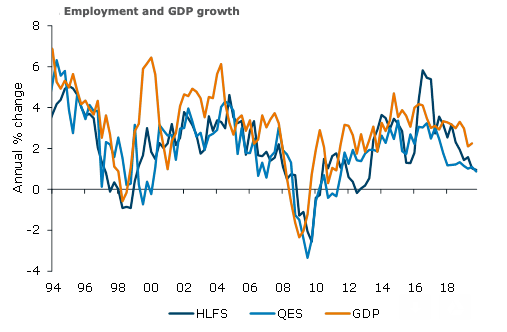
Employment growth in Q4 was weak, with HLFS employment (a survey of households) flat q/q. Annual employment growth was also flat at 1.0 percent, and continues to move within the broad range of indicators. QES employment (from a survey of businesses) was also modest. QES filled jobs rose 0.1 percent q/q, with annual growth slowing from 1.1 percent in Q3 to 0.9 percent.
But offsetting the slowing in employment growth in terms of labour market capacity pressures, growth in the working-age population continues to slow. The participation rate ticked down 0.3 percentage points to 70.1 percent, but remains at a historically high level.
In addition to employment, hours worked can provide an indication of economic activity and slack, though it can be noisy. QES hours paid (which tends to track GDP growth over history) grew 0.6 percent q/q, with annual growth lifting 0.5 percentage points to 1.6 percent.
This is consistent with our current forecast of 0.5 percent q/q (1.7 percent y/y) for Q4 GDP growth. On the other hand, HLFS hours worked (which is far more volatile) posted a 0.5 percent q/q decline, pushing annual growth from 2.3 percent to just 0.5 percent.
Public sector wage growth came in at 0.8 percent q/q, pushing annual growth from 3.0 percent in Q3 to 3.2 percent in Q4. Teacher, nurse, and police pay settlements have bumped up public sector wage growth in previous quarters.
Today’s data will be incorporated into the RBNZ’s February MPS forecasts (out next Wednesday), and are unlikely to have a material impact on their outlook, but they will certainly add to the stronger starting point compared to the November MPS, the report added.
"That said, emerging risks related to the novel coronavirus will be weighing on their thinking and assessment. Developments regarding this tragic shock are fast moving and the impacts highly uncertain. We expect the RBNZ to keep the OCR on hold at 1% next week, acknowledging these risks and emphasising their willingness to provide additional stimulus if required," ANZ Research further commented in the report.







