


 Mike Rogers Calls for End to US-Canada Tariff War
  US, EU Push for Action Against Asia’s Excess Factory Capacity
  Iran Refuses to Halt Uranium Enrichment Amid US Nuclear Demands
  Gold Prices Fall as Fed Signals Another Rate Hike
  France to Release 10 Million Barrels of Diesel to Ease Fuel Prices
  US Treasury Yields Ease After Strong 10-Year Auction as Global Bonds Struggle
  Gold Prices Rise as Hormuz Tensions Fuel Inflation Risks
  Deere, CNH and AGCO Stocks Fall as FTC Launches Farm Equipment Probe
  Oil Prices Slip as Trump Rules Out Iran Strike Before Midterms
  Fed Minutes Signal Another Rate Hike by Year-End
  FxWirePro: Daily Commodity Tracker - 21st March, 2022
  Oil Prices Trim Gains After Trump Rules Out Iran Strikes Before Midterms


 Add as a preferred source on Google
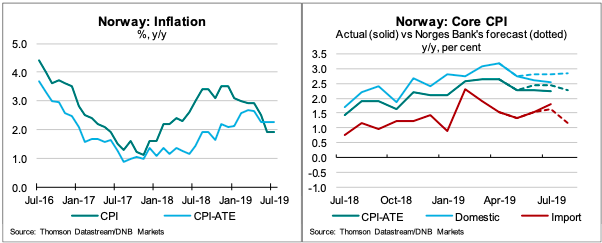
Norway’s core inflation came in path at the September meeting. However, the inflation outlook is not expected to be decisive for if Norges Bank will commit to a September hike at the meeting next week or not.
The weakness in growth among Norway’s trading partners and the escalation of the trade war make markets expect Norges Bank to signal a more cautious stance at the meeting next week (read our preview here).
"We still believe Norges Bank will repeat the sentence “…the policy rate will most likely be increased further in the course of 2019”, but no longer single out September as the most likely meeting for the next hike," DNB Markets reported.
"We expect the hike to be postponed to December. Core inflation (CPI-ATE) was 2.2 percent y/y in July, down from 2.3 percent in June," the report added.
Core inflation only fell by 0.01 percentage-point from 2.258 percent to 2.245 percent. Consensus expected 2.2 percent, according to Bloomberg and Norges Bank projected 2.4 percent in the June MPR. Prices on imported goods rose by 1.8 percent y/y in July, up from 1.5 percent y/y in June.
Other core prices rose by 2.5 percent y/y in July, unchanged from June. (Due to rounding it seems like there is inconsistency between the core inflation number and import and domestic inflation).
Meanwhile, the total consumer price index rose by 1.9 percent y/y in July, unchanged from June. Bloomberg Consensus expected 1.8 percent, Norges Bank forecasted 1.8 percent, vs expectations of 1.7 percent. EUR/NOK fell approximately 2 percent after the release.







