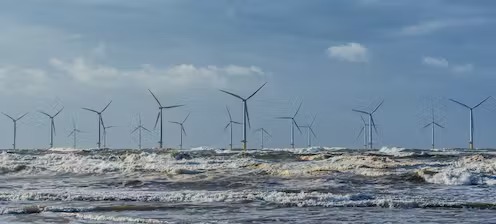
In what many have deemed a disaster, the UK government’s latest auction for renewable power – an annual attempt to incentivise private sector investment in a range of power sources – has failed to bring forward any new offshore wind projects. Consequently, the government’s own target of achieving 50 gigawatts of offshore wind capacity by 2030 is hanging by a thread, and investor confidence has hit a new low.
The UK’s rollout of offshore wind has been one of the few sustained successes the government could turn to in recent years. Supported by the Contracts for Difference (CfD) scheme – the shining star of the government’s low-carbon policy suite – the price of offshore wind has consistently fallen further than expected in each round of auctions.
Through the CfD scheme, developers are guaranteed a fixed price for the electricity they generate over the first 15 years of a project’s lifespan. The price is determined in a competitive auction where developers must submit bids below a maximum cap set by government, known as the “administrative strike price”.
The CfD scheme, which has been adopted by governments throughout Europe and beyond, has been widely acknowledged for its pivotal role in driving down the cost of offshore wind. These fixed-price contracts significantly lessen investor risk, which in turn reduces the overall cost of these capital-intensive projects. This is because investors with a lower risk appetite will enter and lend their money at lower interest rates.
Since the first CfDs were signed in 2014, offshore wind costs have fallen an impressive 74%. However, this trend has taken a different turn over the past year. Project costs have been rising, partly due to the highest inflation rates seen in 30 years. And, for the first time, not a single offshore wind project was able to bid below the cap set by the government in the latest round of auctions.
This has led some to question whether the UK’s era of cheap offshore wind is over. However, in reality, offshore wind remains one of the cheapest and most suitable technologies available to the UK for the energy transition.
Rather than pondering this particular question, the focus should instead be on finding solutions to restore confidence in the UK’s offshore wind sector and developing a plan for the strategic delivery of what is expected to be the dominant technology in the UK’s future electricity system.
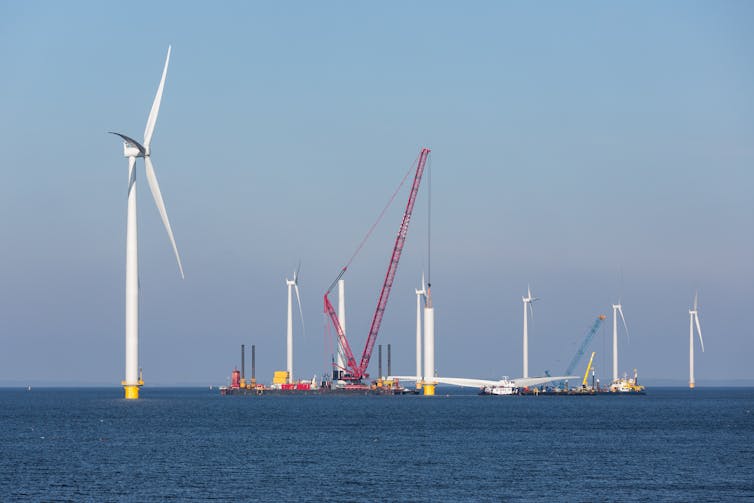
Inflation has caused the cost of building a wind farm to soar. T.W. van Urk/Shutterstock
Why are costs going up?
The primary factor driving up the cost of delivering a new offshore wind project mirrors a predicament that is currently facing us all – inflation has made things more expensive to buy and money more expensive to borrow. The rate at which prices are rising is starting to fall, but remains significantly above where it was two years ago. For those involved in the construction of an offshore wind farm, this means the cost of both the physical parts (such as the turbines) and the debt (bank loans) has gone up.
This issue is not limited to offshore wind technology alone. The cost of both onshore wind and solar power also increased in the latest auction. And if one were to build a new gas-fired power station, it would also cost more today than it did a year ago.
The assertion that rising costs mark the end of cheap offshore wind is therefore misleading. What truly matters is the relative cost, and offshore wind remains cheap relative to other technologies.
There is, however, a second issue contributing to the increased cost of offshore wind – an increasing imbalance between supply and demand in the supply chain. With increasing numbers of offshore wind projects coming forward in recent years, both in the UK and abroad, there is more demand for parts and labour. But supply chain capacity is slow to catch up.
The supply chain companies currently in the market can therefore command higher prices for their materials and services until more production capacity enters the market. However, that new investment in capacity will not come forward unless industry has confidence that the UK will build offshore wind projects at the rate required to hit government targets.
Shifting the focus
Technology costs will not continue to fall indefinitely. Government forecasts even suggest we have probably reached the bottom. So, to lower the cost for the entire fleet of projects required to reach net zero, the emphasis needs to shift towards efficient project delivery rather than a sole focus on technological advancements.
The government should therefore focus on producing a long-term delivery plan for the offshore wind sector. This plan should include the amount of offshore wind it wishes to procure in each auction, delivering confidence to industry and allowing the development of a healthy supply chain.
It could also include standardisation of technology to maximise further cost reductions and accelerate delivery. And it should include updates to the CfD scheme design, such as making auction caps more reflective of current costs so that consumers do not miss out on the cheapest forms of electricity.
The UK government met the challenge of reducing the cost of offshore wind. Now it must rise to the challenge of ensuring that this sector – the backbone of the UK’s future electricity system – is actually delivered.