


 Asian Stocks Mixed as OpenAI Revenue Concerns Hit Chipmakers
  Gold Prices Rise as Dollar Weakens, Treasury Yields Fall
  Oil Prices Slip as Trump Rules Out Iran Strike Before Midterms
  US-Led Coalition Targets Global Factory Overcapacity
  Oil Prices Trim Gains After Trump Rules Out Iran Strikes Before Midterms
  Gold Prices Hit One-Week High as Oil Falls, Fed Rate Outlook Weighed
  US Dollar Rises for Fourth Week as Fed Rate Hike Bets Grow
  RBI Raises Repo Rate to 5.50% in Hawkish Shift on Inflation Risks
  US Dollar Hits 18-Month High as Fed Signals More Rate Hikes


 Add as a preferred source on Google
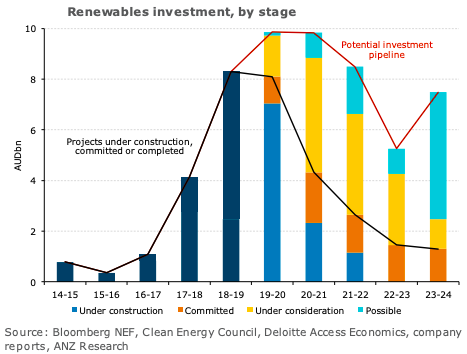
The outlook for strong investment growth and further renewables capacity, particularly in regional areas of Australia, is very strong, according to the latest report from ANZ Research.
Renewable projects have added to Australian business investment, and are now contributing around 16 percent of major projects capital spending. Renewables have become a bigger share of electricity generation as investment has risen, putting downward pressure on electricity prices.
Their increasing share will create challenges for grid stability until battery capacity is more developed, and this remains a policy issue. Investment in major renewable energy projects has reached a record level, the report added.
Of the major renewable energy projects, the total capital spend in 2018-19 was estimated at AUD8.3 billion. The potential pipeline is expected to grow to close to AUD10 billion in 2019-20 and 2020-211, up from below AUD2 billion in the mid-2010s.
Prior to 2017, the backdrop for large renewables investment was not as supportive as it is now. Demand for electricity was soft and even fell in 2011-12 and 2012-13, following the global financial crisis (GFC ) and the fading mining boom.
Hydro continues to be Australia’s largest contributor to renewable generation, with a 36 percent share in 2017-18. Wind contributed 34 percent of renewable electricity in 2017-18 and solar 23 percent. Australia’s only geothermal plant closed in 2016-17.
"We expect renewables investment to grow further. This is based on the current strong pipeline of projects, reflecting pent-up investment appetite, corporate sourcing of renewable energy, ongoing technological improvements including in battery storage, and pro-active government policies," ANZ Research further commented in the report.
Meanwhile, another mega-project is the Asian Renewable Energy Hub, proposed by a consortium, for Western Australia’s Pilbara. That hybrid wind and solar project would generate up to 15GW. The capital spend is expected to be AUD22 billion, invested over a six- to seven-year period from the early to mid-2020s. As well as supplying the local market, the hub would export to South East Asia via sub-sea electrical cables.







