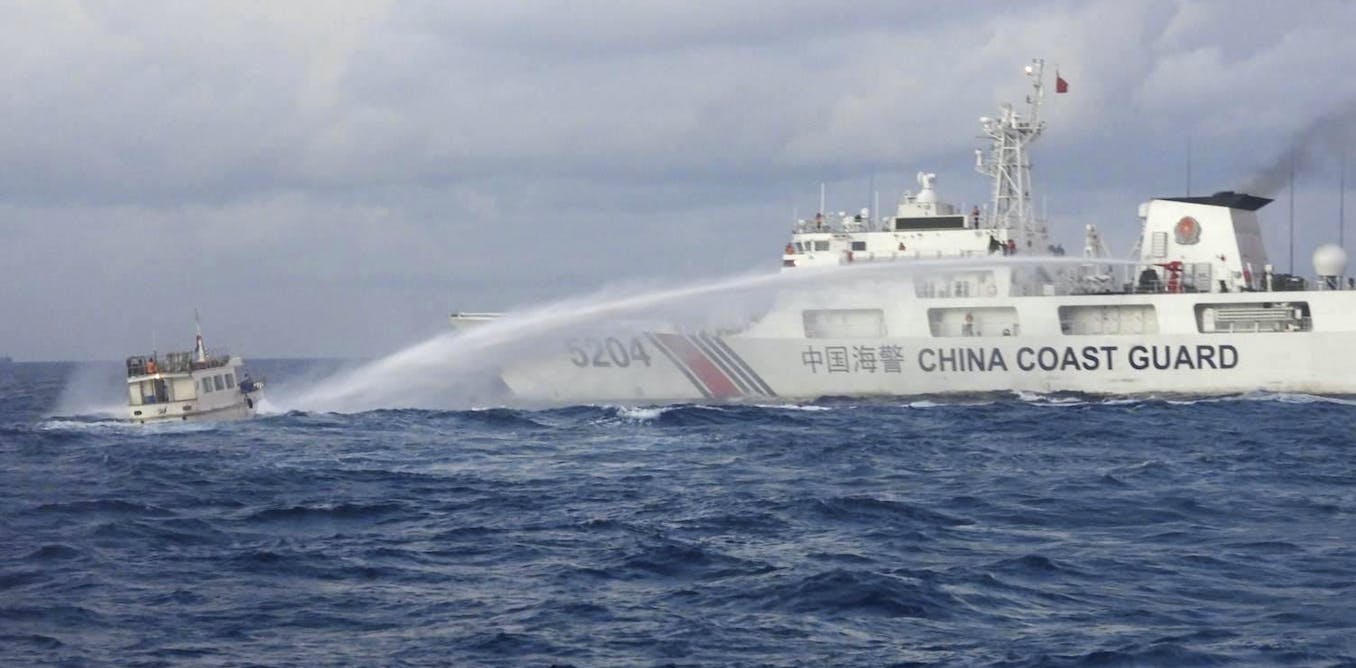
The Philippine Coast Guard (PCG) has deployed an aircraft to challenge a Chinese deep-sea research vessel spotted operating near the northern Philippines, underscoring rising maritime tensions in the West Philippine Sea and broader regional security concerns in the Asia-Pacific.
In a statement released Tuesday, the PCG said its aircraft was dispatched after the Chinese research ship, identified as the CRV Tan Suo Er Hao, was detected approximately 19 nautical miles off the coast of Cagayan province in northern Luzon. The vessel, which serves as a base for submersible operations, was observed inside the Philippines’ Exclusive Economic Zone (EEZ), raising concerns over possible unauthorized marine research activities.
According to the PCG, the pilot issued multiple radio challenges requesting the Chinese vessel to clarify whether it was conducting marine scientific research without Manila’s consent. Under Philippine law and international maritime conventions, foreign research activities within the country’s EEZ require prior authorization. The Chinese ship reportedly did not respond to any of the radio calls.
The 87.25-meter-long deep-sea research vessel had departed from China’s Hainan province earlier this month before entering the western portion of the Philippine EEZ. After initial detection near the Cagayan coast, the PCG continued monitoring the vessel as it moved eastward to about 55.8 nautical miles off Santa Ana, Cagayan.
Cagayan holds strategic importance as the northernmost province of Luzon and lies relatively close to Taiwan. The area also hosts one of nine Philippine military sites accessible to U.S. forces under the Enhanced Defense Cooperation Agreement (EDCA), adding a geopolitical dimension to the incident.
The PCG noted that the Chinese vessel was detected using Canada’s satellite-based Dark Vessel Detection system, a technology designed to track ships that may not be transmitting standard identification signals. The detection coincided with heightened regional tensions, as China conducted large-scale military drills around Taiwan, known as “Justice Mission 2025,” involving simulated strikes and blockades.
The Chinese Embassy in Manila has not yet issued a response regarding the incident. The encounter highlights ongoing concerns over maritime security, sovereignty, and freedom of navigation in Philippine waters amid increasing regional military activity.