


 Iran Tanker Attacks Surge as Hormuz Oil Flows Near Prewar Levels
  OPEC+ Keeps November Oil Output Targets Steady
  Lula Weighs Alckmin as Finance Minister to Boost Fiscal Credibility
  ISIS Attack Near Kirkuk Kills Iraqi Policeman After US Withdrawal
  France Student Protests Intensify Nationwide
  Trump Gaza Peace Plan Stalls as Israel Retains Control
  Becton Dickinson to Invest $3 Billion in U.S. Medical Manufacturing
  Cuba Says US Contacts Continue but Formal Talks Remain Stalled
  OpenAI, Anthropic Back Mandatory AI Breach Reporting in Australia
  Flavio Bolsonaro, Lula Head to Brazil Election Runoff
  Australia Probes Flydubai Co-Pilot’s Links After FZ1073 Hijack Attempt
  North Korea Slams US Taiwan Arms Sales, Reaffirms Russia Support
  New York Declares Measles Disaster Emergency as Cases Surge
  Takaichi Pledges to Control Japan Bond Issuance
  Zelenskiy Warns Russia Is Preparing Massive Attack on Ukraine
  Fairshake Backs 32 Pro-Crypto House Candidates
  Flavio Bolsonaro Surges as Family Scores Brazil Election Comeback


 Add as a preferred source on Google
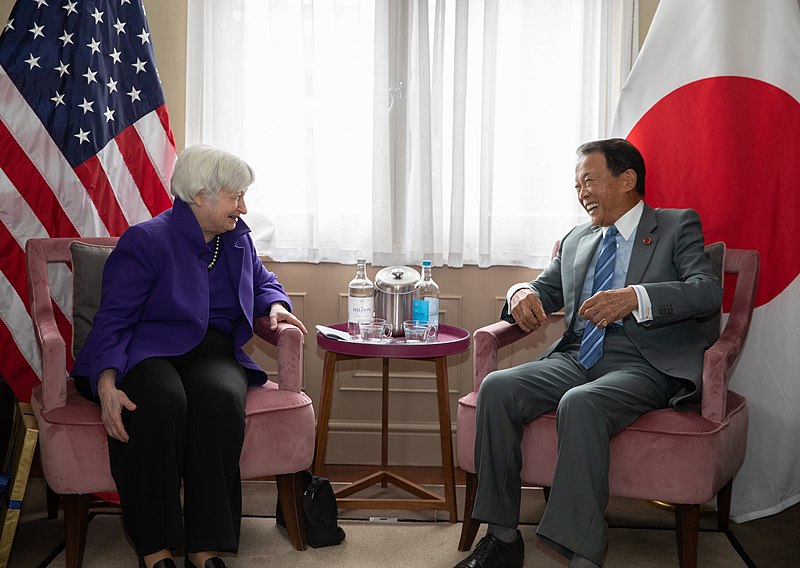
The war that Russia continues to wage on Ukraine has exacerbated the rising prices of gasoline and food. The United States and Japan this week agreed to address the economic impact of the war in Ukraine on the world.
US Treasury Secretary Janet Yellen and Japanese Finance Minister Shunichi Suzuki agreed to coordinate in addressing the economic impact of the war in Ukraine, which is moving toward its fifth month.
The two finance officials agreed to tackle the rising prices of food and energy products and volatility in currency markets that were worsened by Russia’s invasion of Ukraine.
Both officials said the war increased the exchange rate volatility, which would lead to implications for economic and financial stability, and pledged to cooperate on currency issues.
“We will continue to consult closely on exchange markets and cooperate as appropriate on currency issues, in line with our G7 and G20 commitments,” said the officials in a joint statement following the meeting.
The two finance officials also reiterated their mutual condemnation of Russia’s “unprovoked, unjustifiable, and illegal” war on Ukraine that began when Russians invaded Ukraine back on February 24 in what the Kremlin calls a “special military operation.”
They also agreed to increase Russia’s cost of its war by imposing further economic and financial sanctions.
They also urged China and other nations to cooperate in a constructive manner in helping low-income countries that are facing debt and other issues such as climate change and global tax reforms.
Meanwhile, Ukraine said Tuesday that it has carried out a long-range strike against Russian forces in Ukraine’s southern territory, including Russian military equipment, as Ukrainian troops are looking to recapture the southern territories in a counter-offensive with thousands of troops.
An ammunition dump at the Nova Kakhovka in Kherson was hit by the rockets, killing 52 Russians, according to Kyiv. This follows the United States’ supplying of Ukraine with HIMARS missile systems which Ukraine said its forces are using effectively.
The area that Ukraine struck was among the areas Russian forces seized after it invaded and is also of strategic importance with access to the Black Sea, which is also north of the Russian-annexed Crimea region.







