Samsung Electronics sets a new benchmark in the tech industry with its pioneering GDDR7 DRAM, pushing limits in speed, energy efficiency, and data transfer capabilities, all while reducing power consumption.
Meet the graphics double data rate 7 (GDDR7) DRAM, the first of its kind in the memory series, announced by the tech giant based in South Korea. In the coming year, the chip will be integrated into the cutting-edge systems of Samsung's most valued customers for meticulous testing and verification.
Surprisingly, it has been only a year since the company unveiled the GDDR6 DRAM, capable of an impressive 24 gigabits per second (Gbps), which at the time was unprecedented. This chip was specifically designed for high-performance applications.
Now, Samsung's latest creation takes the lead, boasting a data transfer speed of 32 Gbps, the fastest in the industry. Astonishingly, it outperforms its predecessor, the GDDR6, by 1.4 times.
The power consumption of the GDDR7 is also significantly lower, consuming 20% less energy than the previous model. This feature makes it ideal for operations with demanding speed requirements. Additionally, the new product offers a low-operating voltage option, ensuring an optimal experience for power-sensitive applications like laptops.
Bae Yong-cheol, the executive vice president of Samsung's memory product planning team, affirms that the GDDR DRAM will greatly enhance user experiences in areas that heavily rely on exceptional graphic capabilities, such as workstations, PCs, and game consoles. He also highlights the potential use of this product in fields such as AI, high-performance computing, and autonomous vehicles.
The groundbreaking speed of 32 Gbps was achieved by employing the pulse amplitude modulation 3 (PAM3) signaling method. This innovative approach allows the transmission of 50% more data within the same signaling cycle compared to the non-return to zero (NRZ) method, previously used in similar models.
When combined with a graphics card, the GDDR7 showcases a remarkable bandwidth of 1.5 terabytes per second (Tbps), a 1.4 times improvement over GDDR6's 1.1 Tbps, according to Samsung's reports.
Complementing its impressive features, the latest chip incorporates an innovative integrated circuit design and packaging that minimizes heat generation. Samsung proudly reveals that compared with the GDDR6, the new chip's thermal resistance has been reduced by an astounding 70%. This technological feat allows stable and reliable performance even under high-speed operating conditions.
It is worth mentioning that the development of GDDR7 memory has been an industry-wide endeavor. However, Samsung is the prime memory vendor ready to bring this revolutionary product to market.
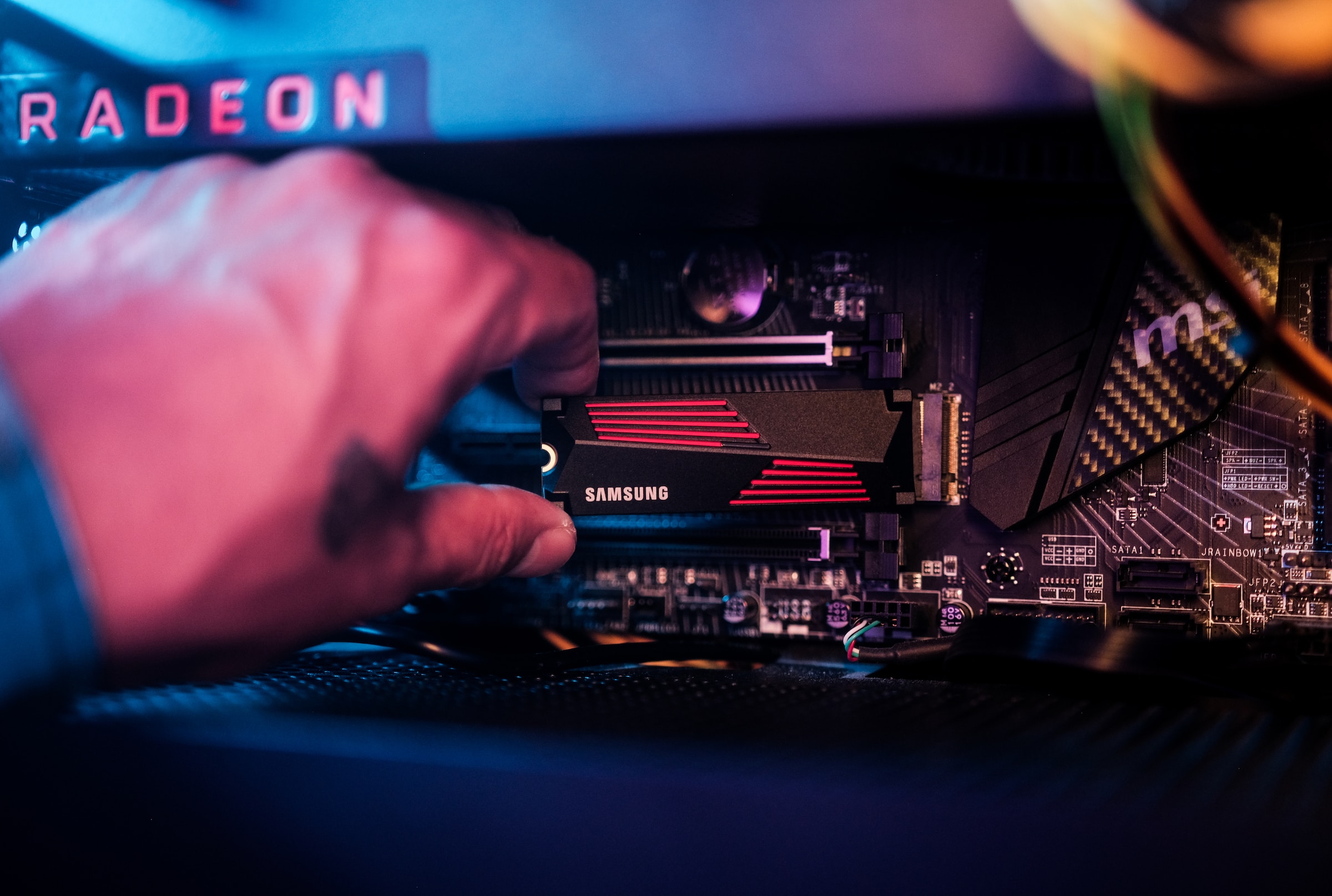
Photo: Samsung Memory/Unsplash