


 HUTCHMED, AstraZeneca Seek FDA Approval for Lung Cancer Combo
  AstraZeneca Halts Phase III Volrustomig Lung Cancer Trial After Efficacy Setback
  Moderna Wins FDA Approval for mFLUSIVA mRNA Flu Vaccine for Adults 50+
  Novartis M&A Strategy Faces Investor Scrutiny After Drug Setbacks
  Eli Lilly Eyes AtaiBeckley Acquisition to Expand Psychedelic Mental Health Pipeline
  Sanofi, Regeneron Expand Drug Partnership in $8 Billion Deal
  New Mexico Measles Outbreak Cost Reached $5.4 Million, Study Finds
  Novo Nordisk Eyes Turnaround as Oral Wegovy Challenges Eli Lilly in Weight-Loss Drug Race
  Moderna Short Sellers Hit With $4.8 Billion Loss as Stock Soars
  Hanmi Pharm Soars 30% on $2.3 Billion Genentech Obesity Drug Deal
  Hims & Hers Shares Fall as GLP-1 Costs Widen Q2 Loss
  FDA Investigates New Cyclospora Outbreak as U.S. Cases Continue to Rise
  GLP-1 Weight-Loss Drug Use Surges Among U.S. Children
  Novo Nordisk Raises 2025 Outlook Despite Wegovy Pill Miss and CagriSema Setback


 Add as a preferred source on Google
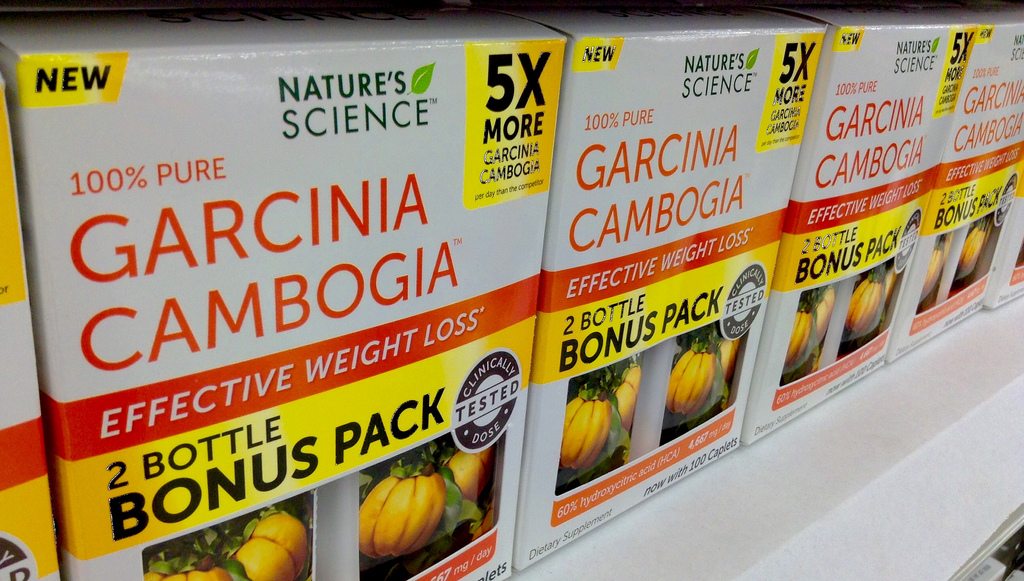

The burgeoning field of complementary medicines, including weight-loss products, is now a billion-dollar industry. Every year, more people are spending disposable income on complementary and alternative medicines that may prove to have no benefit for our health.
Garcinia Cambogia is one such example. Marketed as a weight-loss pill, it has had an exponential rise in sales since it was featured on the Doctor Oz show.
Garcinia cambogia is the former scientific name of a native Southeast Asian plant, belonging to the family Clusiaceae, that bears a pumpkin-shaped fruit. The skin of the fruit contains the active ingredient, hydroxycitric acid (HCA). HCA inhibits an enzyme that produces fatty acid, thus suppressing fatty acid and the processing of cholesterol.
But does this mode of action translate to the weight-loss claims associated with it? Or is it just clever marketing convincing us this product helps us lose weight?

An Australian advertisement for the weight-loss supplement Garcinia Cambogia. Screenshot, http://www.garciniacambogiasave.com/, CC BY
Double-blinded, randomised controlled trials are the gold standard of clinical study and whenever possible should be conducted to test the effectiveness of a treatment compared to a placebo. Weight-loss products should be assessed for a minimum of six months, with a further six-month follow-up period (12 months total).
There has never been a long-term study investigating the efficacy of Garcinia Cambogia. Most of the studies have been conducted in animals.
In fact, the majority of well-designed trials investigating the effect of this product on weight loss have found no effect that is of clinical relevance. In a 12-week double-blind, placebo-controlled trial conducted in humans, people receiving 3000mg of Garcinia Cambogia extract (1500mg of the active component HCA) per day lost the same amount of weight as the control group.
Another 12-week study with a four-week follow-up (16 weeks total) also found no greater weight-loss effect than for a placebo control group. For those studies where a statistically significant effect was reported, the weight loss was around one kilogram more than for those receiving a placebo pill.
Positive and greater weight losses were found in some studies, but this effect is suppressed when looking at all of the studies combined.

The Garcinia Cambogia plant Livia Lacolare/Flickr, CC BY
With respect to other health benefits from taking this supplement, the evidence to suggest it can improve blood cholesterol levels is lacking.
Most importantly, the product safety profile of Garcinia Cambogia has been adequately tested and there appear to be no issues.
Some complementary medicines have been found to contribute to improved health outcomes, through increased efficacy and cost-effectiveness. However, if there is to be a role for such complementary and alternative weight-loss products and medicines, we must build upon the evidence to investigate whether these increasingly popular products are a viable treatment option.
A recent Obesity Australia and Price Waterhouse Coopers report found obesity cost Australia A$8.6 billion in 2011-2012, with the indirect costs far higher. We must establish whether complementary medicines have a role to play in preventing and treating obesity. If we take no action to reduce obesity rates, an additional 2.4 million people will become obese at a cost of $87.7 billion over 10 years.
 Dr Nicholas Fuller has received research grants for other clinical trials funded by Australian Egg Corporation, Weight Watchers International, SOHO Flordis International, Arnotts Biscuits, Sanofi-Aventis, Novo Nordisk, Allergan, Roche products, MSD, and GlaxoSmithKline.
Nick Fuller, Research Fellow, Clinical Trials Development and Assessment, University of Sydney
This article was originally published on The Conversation. Read the original article.







