
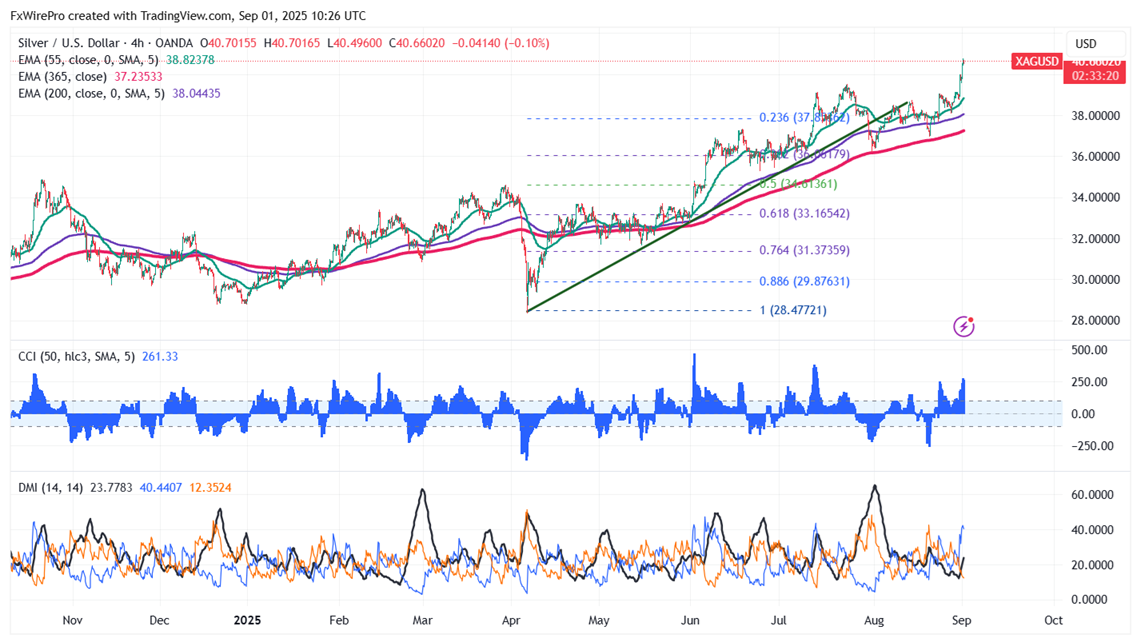
Silver hits a fresh year high on rate cut hopes. It hit an intraday high of $40.75 and is currently trading around $40.52.
Rising expectations of Federal Reserve interest rate reductions have propelled silver prices beyond $40 per ounce, their highest level since 2011. Market momentum has turned sharply toward precious metals with an 87.6% probability of a rate cut in September 2025. Lower rates of interest increase inflation expectations, weaken the US dollar, and lower the opportunity cost of holding silver—essential factors propelling demand for silver as a store of value. Silver's upward trend is further strengthened by other elements, including the US Dollar Index dropping to monthly lows around 97.60 and monetary growth via treasury purchases.
Demand for silver from industry provides yet another layer of support, powered by developments in electronics manufacturing and clean energy technologies, including solar panels. Given supply shortages expected for a fifth straight year and institutional investor inflows at their highest levels since 2020, the scene is set for continuous momentum. Silver seems ready for ongoing near-term growth as financial easing and strong industrial uses meet.
Trading Strategy and Key Levels for Silver
The commodity is trading above the short-term (34 and 55 EMA) and long-term moving average (200 EMA) in the 4-hour chart. The near-term support is around $39.80, and any violation below will drag the commodity to $39.28/$38.80/$38/$37.78/$37.30/$36.65/$36.17/$35.70/$35.47. The immediate resistance is at $41; any breach above targets $41.60/$43/$44.
It is good to buy on dips around $39.28-30 with a stop-loss at $38 for a TP of $41.60/$43.


