
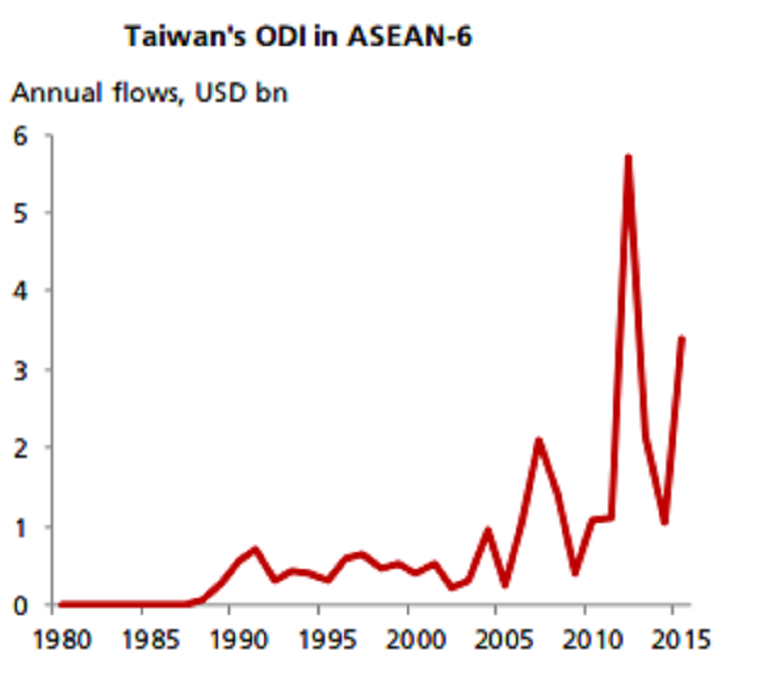
Taiwan’s direct investment in the ASEAN-6 has doubled over the past five years and has plenty of room to grow further. China’s slowdown, rebalancing and rising wages are prompting Taiwanese firms to adjust overseas investment strategies.
Taiwanese firms are diversifying investment into Southeast Asia. Outward direct investment (ODI) in ASEAN-6 countries rose to USD 2.7 billion per year in 2011-15, more than double the USD 1.2 billion invested annually in 2006-10.
Fifteen percent of all Taiwanese ODI now goes to the ASEAN-6, up from 6 percent in 2006-10. By contrast, the share of mainland China in Taiwan’s ODI appears to have peaked. It has fallen persistently over the past five years, from 84 percent in 2010 to 51 percent in 2015.
ASEAN markets are attractive, thanks to strong growth, low-cost labor, and ongoing reforms and economic integration. Also, Taiwanese firms are already motivated to invest overseas. This is bolstered by the government’s 'New Southbound Policy', aimed at strengthening ties with South and Southeast Asia
Singapore and Vietnam remain the most favorite markets for Taiwanese investors so far. Indonesia and the Philippines have the potential to attract more Taiwanese investors in the longer-term. That said, regional economic integration could allow foreign firms invested in ASEAN to tap a deeper and broader market.
The ASEAN Economic Community (AEC) has been established late last year. Aiming to transform the region into a single market, the AEC will promote free movement of goods, services, investment and skilled labor across the member countries.
Considering the low base, there is much scope for Taiwan to increase direct investment in South-East Asia. On current trends, Taiwan’s ODI in the ASEAN-6 will average about USD 6 billion per year during the 2016-2020 period. ASEAN’s share in Taiwan’s total ODI will rise further to 24 percent, DBS reported.

